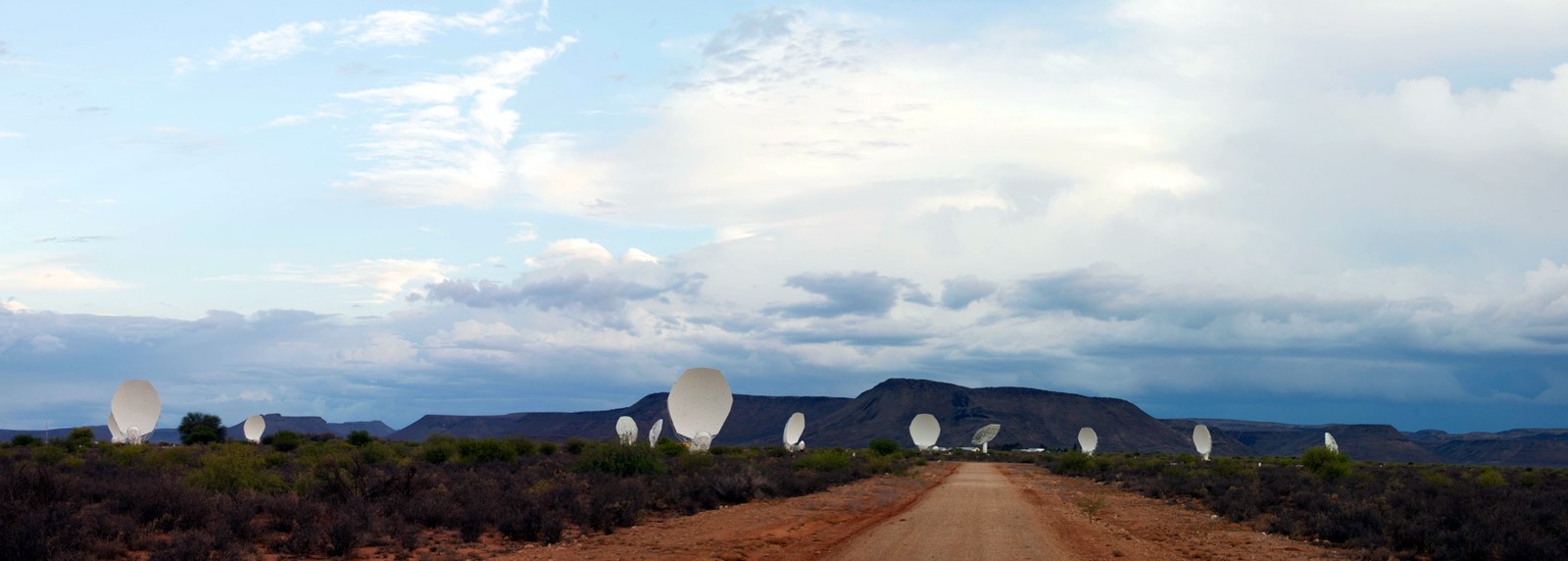
Astronomers report the first radio emission unambiguously traced to a planet outside our solar system rather than its host star. The bursts came from Beta Pictoris b, a young gas giant about 63 light-years away, and were detected with South Africa's MeerKAT array. The planet called, but the message was basically magnetic weather.
The signals were rapid, recurring and strongly circularly polarized. Those characteristics match electron cyclotron maser radiation, the process that produces powerful auroral radio emissions around magnetized planets including Jupiter. Researchers localized the source to the planet and distinguished it from activity on the nearby star.
The measured frequencies imply a magnetic field of at least roughly 1.25 kilogauss, far stronger than Earth's and substantially stronger than Jupiter's. This is the first direct field-strength measurement of its kind for an exoplanet, giving scientists a new way to study planetary interiors and magnetospheres from across interstellar distance.
Magnetic fields matter because they influence how atmospheres interact with stellar wind and energetic particles. For smaller rocky worlds, those interactions can affect atmospheric survival and habitability. Beta Pictoris b itself is a massive, hot planet and is not being presented as an Earthlike home.
The radio bursts are not evidence of intelligent extraterrestrials. Researchers identify a natural auroral mechanism, not a coded transmission or technological beacon. A signal from another planet is exciting, but 'radio' does not automatically mean somebody built a station, subscribed to a podcast or wants us to phone back.
The discovery expands the toolkit for examining planets that cannot be visited or photographed in surface detail. Future radio observatories may measure magnetic environments around more distant worlds. The scientific headline is already extraordinary: humanity has heard the aurora of another planet. No imaginary broadcaster required.
Sources and image information
Ortiz Ceballos, Berger and Cendes, arXiv, Sept. 15, 2026: https://arxiv.org/abs/2609.16720; Live Science, Sept. 2026: https://www.livescience.com/space/exoplanets/astronomers-detected-radio-signals-coming-from-an-exoplanet-for-the-first-time-spoiler-alert-its-not-aliens
Photograph: Square Kilometre Array Organisation (SKAO) / South African Radio Astronomy Observatory (SARAO); CC BY 3.0. Original file and rights record: Wikimedia Commons.

Facts first. Side-eye included.
DJF separates what is confirmed from what is claimed—and tells you why this particular mess is worth your time.