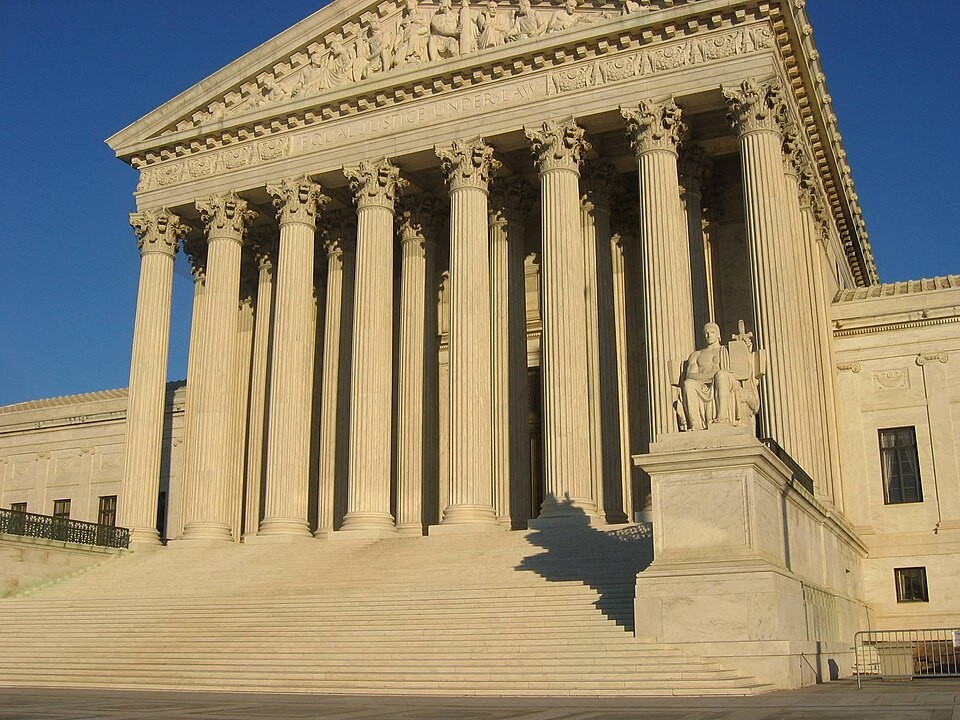
The BMG Vetter copyright case ended at the Supreme Court on October 19 with an unusual personnel problem. Four justices took no part, leaving the Court without a quorum. Its order affirms the lower-court judgment under the statute governing that situation. This is not a fresh majority opinion settling the worldwide reach of copyright termination. Even a story about a song called “Double Shot” needs to count the chairs.
The dispute concerns songwriter Cyril Vetter’s reclaimed rights in “Double Shot (Of My Baby’s Love).” Reuters reports that the Fifth Circuit upheld his worldwide ownership claim in January after he invoked copyright termination. Music-publishing companies sought review. The lower-court result remains in place, but readers should distinguish that practical result from a reasoned Supreme Court endorsement of the underlying interpretation.
The official order names Justices Sotomayor, Gorsuch, Barrett and Jackson as taking no part. It does not explain their individual reasons. We are not going to supply motives with a calculator and some vibes. The docket and order are linked below so the procedural language can be checked directly.
Our take: this belongs in the music beat because the life of a song includes more than its time on the radio. Who owns it decades later can matter just as much to its creator as whether another generation recognizes the opening. Nostalgia is pleasant. The paperwork attached to nostalgia is considerably less cuddly.
For listeners raised on tapes, records and liner notes, it is easy to imagine a recording as a settled object. The business interests around a composition are not necessarily settled simply because the song is old. A familiar tune can remain the subject of a very current ownership fight. The music does not stop being culture when somebody opens a file marked rights.
What makes this ending distinctive is the gap between outcome and explanation. The songwriter keeps the benefit of the judgment, while the broader legal debate has not received a new merits analysis from the justices. Calling that a loss for the petitioners is fair. Calling it a sweeping new Supreme Court copyright doctrine would give the order a second career it never auditioned for.
The useful takeaway is narrow but consequential: the lower-court judgment stands after a quorum-based disposition. Anyone claiming the Court answered every international copyright question should point to the opinion doing that work. There is no such new merits opinion here. The old song has a current result; the headline can keep both its rhythm and its accuracy.
Sources and photograph
Supreme Court, October 19 order list, pages 1–2. Supreme Court docket, No. 25-1391. Reuters, Blake Brittain, October 19, via AOL.
Archival Supreme Court building photograph, December 2004. Not a photograph of the October 19 proceedings or songwriter Cyril Vetter. Photo: Duncan Lock (Dflock); CC BY-SA 3.0. Display copy resized. Where applicable, the resized photograph retains the stated ShareAlike license. Original photograph and rights record. Image-use terms.

More from this Daily Junk Food section.
Facts first. Side-eye included.
DJF separates what is confirmed from what is claimed—and tells you why this particular mess is worth your time.

Dana Side-Eye
Receipts, Rumors & Internet NonsenseDana reads the fine print, checks the timeline, and keeps one eyebrow permanently raised. She covers viral claims, internet pile-ons, and suspiciously convenient explanations.
“Screenshots are forever. So is the side-eye.”