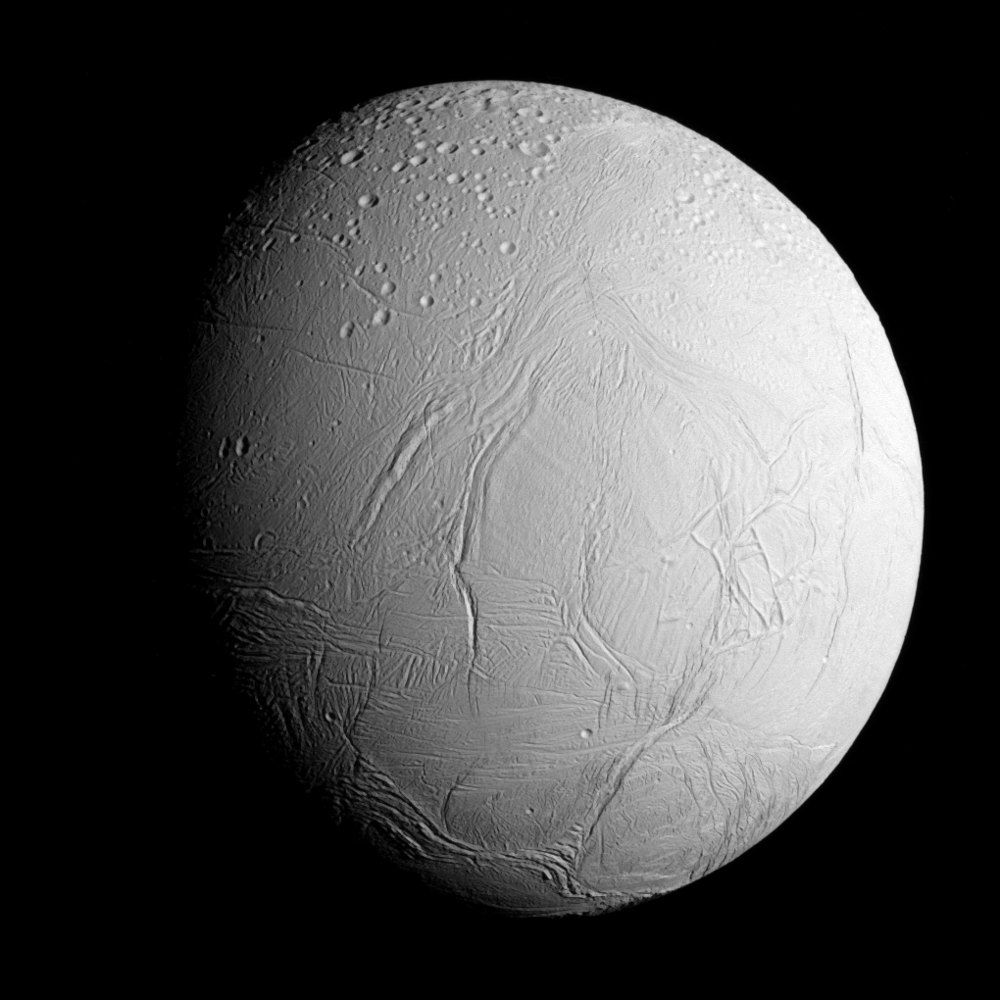
Earth microbes have survived laboratory conditions designed to mimic the ocean beneath the ice of Saturn's moon Enceladus. This is exciting science and absolutely not confirmation that Saturn has tiny roommates, despite what the thumbnail with the green face will tell somebody by dinner.
Researchers recreated an extreme alkaline brine based on evidence gathered by NASA's Cassini mission. They introduced Methanothermococcus okinawensis, a microbe found near hydrothermal vents in Japan's Okinawa Trough. The organism survived and produced methane using hydrogen and carbon dioxide.
Enceladus offers water, chemistry and access
The moon contains a global saltwater ocean beneath an icy shell. Geyser-like plumes shoot material from that ocean into space near the south pole, allowing a spacecraft to sample the contents without drilling through miles of ice—the solar-system equivalent of a laboratory leaving specimens on the porch.
Cassini detected water vapor, salts, organic compounds and evidence of hydrothermal activity in those plumes. Those ingredients make Enceladus one of the strongest places to investigate habitability beyond Earth.
Habitability is not habitation
The experiment shows that at least one Earth organism can tolerate a modeled version of Enceladus chemistry. It does not show that life began there, exists there now or shares biology with Earth. Laboratory simulations necessarily simplify a distant environment that scientists have never directly entered.
A related study suggests that microbes or biological material, if present, could become concentrated in particular ice grains ejected by the plumes. That may help future missions design instruments capable of recognizing faint biosignatures.
Scientists have not found extraterrestrial life on Enceladus or anywhere else. What they have done is make a future search more specific: we know a type of microbe can function under plausible conditions, and we know where material from the ocean escapes. The aliens remain unconfirmed. The moon remains extremely worth visiting.
Facts first. Side-eye included.
DJF separates what is confirmed from what is claimed—and tells you why this particular mess is worth your time.

Wade Crowley
Strange News & Small-Town WeirdWade collects stories that begin with “You are not going to believe what happened at the Walmart.” He covers odd crime, local legends, UFOs, and reality losing the plot.
“Somewhere, a police report is already getting weirder.”