
Historical evidence review · England and Wales · 1999–2008
Forensic testing found one particle of firearms discharge residue in Barry George’s coat pocket. That finding remained part of the record when the Court of Appeal quashed his conviction for murdering television presenter Jill Dando. What changed was the answer to a different question: could the particle help tell who fired the gun?
Dando was killed outside her London home on April 26, 1999. George was convicted at the Central Criminal Court in July 2001 and his first appeal was dismissed in 2002. The Criminal Cases Review Commission’s case summary records what happened after he asked it to review the conviction: fresh expert evidence cast doubt on the significance given to the particle at trial, and the commission referred the case back to the Court of Appeal.
Finding a particle and tracing its source are different tasks
At the original trial, the residue was presented as a piece of the case linking George to the weapon. The particle had similarities to residue from the crime. The prosecution’s experts gave the impression that it was more likely to have come from a firearm fired by George than from another source. That was an inference about how it arrived in his pocket, not just a description of what had been found there.
In George v R, decided November 15, 2007, the appeal judges considered evidence that an outside source was just as plausible as a gun fired by George. The High Court’s 2013 review of later compensation decisions explains the distinction. The new assessment did not identify the actual source of the particle. It showed why the trial jury should not have treated the particle as support for the prosecution’s account over the alternative.
What the two later outcomes established
The Court of Appeal held the conviction unsafe and ordered a retrial. A different jury acquitted George in August 2008. The Supreme Court’s later judgment on compensation law recounts the quashing and acquittal. An appeal judgment explains why the earlier verdict could not stand. The acquittal is the outcome of the retrial. Neither identifies Dando’s killer, and George’s overturned conviction should never be presented as a standing finding against him.
The value of revisiting the record is the difference between a laboratory observation and a conclusion about an event. The first can be sound while the second outruns what the evidence can distinguish. Explore more documented cases in the UK crime collection and the Investigations archive.
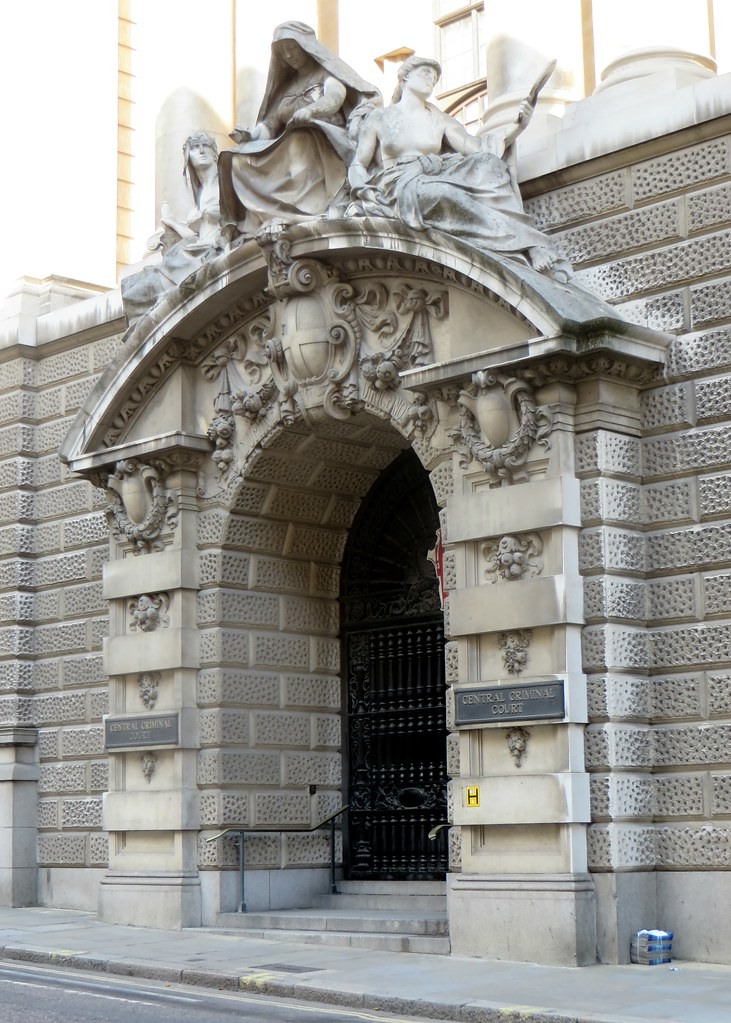
File photograph: Old Bailey Gate, London’s Central Criminal Court, August 8, 2014. Photo by Eden, Janine and Jim, CC BY 2.0. It does not show the trial or retrial. Original photograph · License. Re-encoded for display.