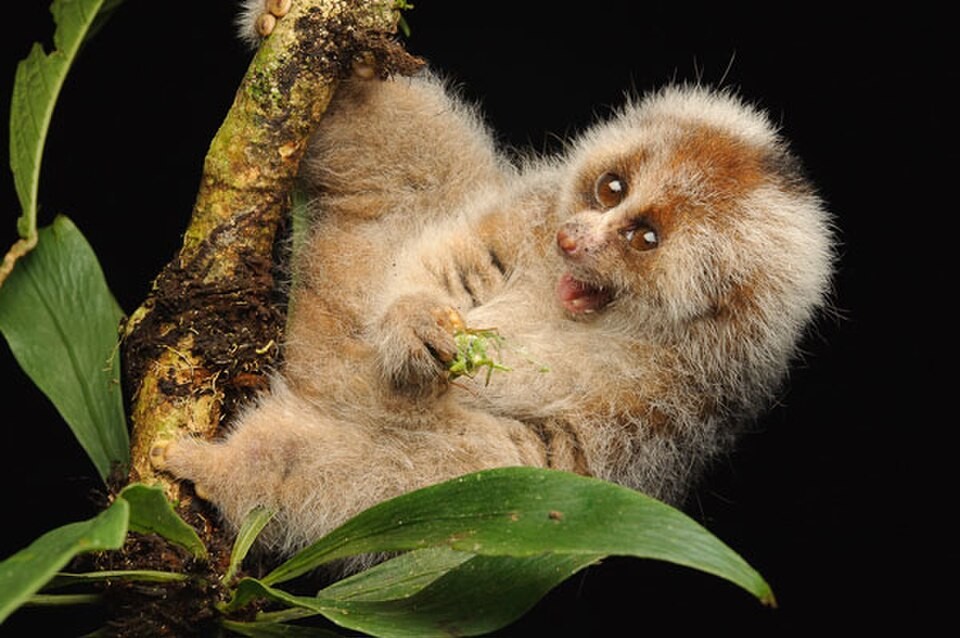
The Bangka slow loris has reappeared in the scientific record after decades of being feared possibly extinct. Researchers reported that a wildlife rescue organization encountered more than 90 individuals on Indonesia’s Bangka Island between 2015 and 2025. The species was last scientifically documented there in the early 1930s, which is an impressively long absence from the group chat.
The Alobi Wildlife Rescue Center found animals in multiple areas of the island, including houses, gardens, plantations and roads. After rehabilitation, 86 were released into suitable habitat, according to Reuters. Several had serious injuries, particularly from electrical wires, and some did not survive treatment. Rediscovery is good news; it is not the same as saying the population is safe.
Nycticebus bancanus is a small nocturnal primate with large eyes, reddish-brown fur and deliberate movement through trees. It is also venomous, a rare mammalian feature. Slow lorises mix a secretion from glands near their elbows with saliva and can deliver it through a bite. Nature apparently decided that moving slowly should not be confused with accepting nonsense.
The species was classified as critically endangered and possibly extinct in 2020. Habitat loss from tin mining and oil-palm expansion remains a major threat. Researchers now want systematic field surveys to determine where the animals survive and how many remain. Ninety rescue records reveal persistence; they do not provide a complete population count.
Our take: “rediscovered” is one of conservation science’s happiest words, but it comes with an invoice. The animal did not return from extinction because humans finally noticed it. It endured while scientific attention was absent and habitat continued to shrink. The celebration makes sense only if it is followed by forest protection and less hazardous development.
The loris also has a toothcomb formed by forward-projecting lower teeth and a specialized second tongue that helps clean it. That sentence sounds like a creature designed during the final hour of a very creative meeting, yet each feature has a practical role in grooming, feeding and venom delivery. Evolution has never been obligated to submit a restrained first draft.
The verified result is survival across several localities and a decade of rescue documentation. It is not proof that the species is abundant or that conservation work is finished. The Bangka slow loris is alive, wonderfully strange and still in danger. Humanity may now proceed to the challenging phase: acting like finding it matters.
Sources and photograph
Reuters, Will Dunham, October 20. Spixiana study linked by Reuters.
Photograph of the Bangka slow loris species; not presented as one of the specific animals documented in the new study. Photo: Gunay M.E.; CC BY-SA 4.0. Display copy resized. Where applicable, the resized photograph retains the stated ShareAlike license. Original photograph and rights record. Image-use terms.

More from this Daily Junk Food section.
Facts first. Side-eye included.
DJF separates what is confirmed from what is claimed—and tells you why this particular mess is worth your time.

Dana Side-Eye
Receipts, Rumors & Internet NonsenseDana reads the fine print, checks the timeline, and keeps one eyebrow permanently raised. She covers viral claims, internet pile-ons, and suspiciously convenient explanations.
“Screenshots are forever. So is the side-eye.”