The Harvest Fuel Relief program now has an $8 billion headline and a familiar companion: details to follow. Donald Trump announced the support at his October 19 Kansas campaign rally. USDA subsequently said the money would fund one-time payments to farmers facing higher input costs and market disruptions. For the person watching the fuel bill, the next interesting number is the payment rate, not the number of adjectives in the announcement.
USDA says the Farm Service Agency will administer the payments under the Commodity Credit Corporation Charter Act. Support will use a uniform formula covering part of modeled 2026 crop-year losses. Rates for Title I commodities are due in November; the methodology for other eligible commodities will be announced later. The release does not give every producer a payment amount or announce that checks have already arrived.
The agency encourages eligible producers to establish a Login.gov account ahead of the application-period announcement, with pre-filled online applications planned for accounts linked to USDA. That is preparation, not a statement that applications are already open. Reuters places the announcement in the closing midterm campaign, with farm-state costs an important political issue.
Our take: relief can matter to a producer and still deserve scrutiny as an election-season announcement. Those ideas can coexist without causing the tractor to explode. The responsible questions concern who qualifies, how losses are modeled, when the application process begins and how quickly the money reaches its intended recipients. A rally crowd cannot answer those questions by applauding harder.
The modeled-loss approach also deserves a plain-language explanation when the rates appear. A uniform national formula is not the same thing as reimbursing each farm’s actual diesel receipts. Readers should not treat the announced total as a guarantee that their own higher costs will be covered in full. The word portion in USDA’s description is doing some heavy lifting.
There is a useful test for the next round of coverage: does it add a usable rate, a defined process or an actual distribution milestone? Repeating the headline total beneath a new photograph does not move the story forward. Nor does predicting the political effect before anyone has voted. We can examine the policy without pretending to know what every farmer thinks of it.
For now, the concrete news is the October 19 commitment, the agency assigned to run it and the timetable for some of the missing rates. The November details will determine how the announcement translates into individual support. Until then, the fuel gauge remains a more practical instrument than the campaign applause meter.
Sources and photograph
USDA, October 19 official program announcement. Reuters, October 20 report on the October 19 Kansas announcement.
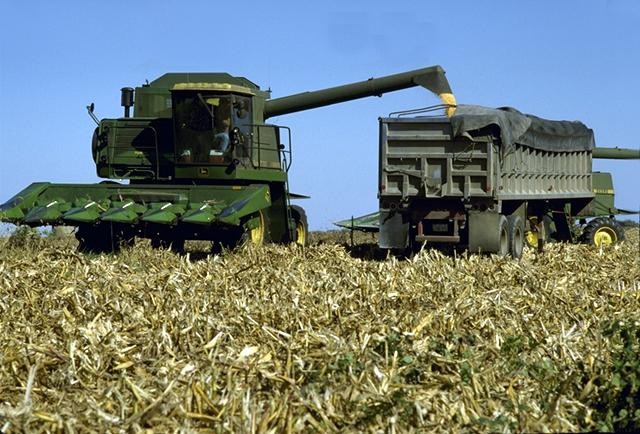
Representative archival USDA harvest photograph; capture date not specified in the source record. Not a documented recipient of the 2026 program. Photo: USDA; individual photographer not identified in source record; Public domain (U.S. federal government). Display copy resized. Where applicable, the resized photograph retains the stated ShareAlike license. Original photograph and rights record. Image-use terms.

More from this Daily Junk Food section.
Facts first. Side-eye included.
DJF separates what is confirmed from what is claimed—and tells you why this particular mess is worth your time.

Dana Side-Eye
Receipts, Rumors & Internet NonsenseDana reads the fine print, checks the timeline, and keeps one eyebrow permanently raised. She covers viral claims, internet pile-ons, and suspiciously convenient explanations.
“Screenshots are forever. So is the side-eye.”