Developing court report and DJF analysis — November 2, 2026. The new deadlines below are attributed to Associated Press reporting. DJF has not independently obtained the November 2 written order; the outcome of the pending request to halt construction remains unresolved.
President Donald Trump's proposed Memorial Circle arch has acquired an inconvenient accessory: a judicial stopwatch. The Associated Press reports that Judge Tanya Chutkan on Monday required notice within an hour of decisions by three reviewing agencies and within thirty minutes of construction-related activity. She also reiterated earlier restrictions requiring final National Park Service authorization and fourteen days' notice before construction or preparatory demolition.
Why the rush is being challenged
Public Citizen's case record explains the longer dispute. The organization represents three Vietnam War veterans and an architectural historian opposing the project near Arlington National Cemetery. Their objection includes its effect on the intended view between the cemetery and the Lincoln Memorial. They also argue that Congress has not supplied the authorization required to build a memorial there. That is the plaintiffs' legal position, not a final judgment we are announcing.
The same record describes an earlier government commitment to provide fourteen days' warning before starting construction. It also documents a renewed injunction request after the administration identified November 5 as a possible starting date. That history matters: Monday's deadline story did not materialize out of a dispute that began this afternoon.
The administration's position deserves space, too. In AP's earlier account carried by WVTF, government attorney Robert Stander defended the project as a priority and argued that judicial intervention would impede government work. The government wants to move forward; challengers want the court to intervene before construction changes the site.
The local stakes go beyond the postcard
Virginia's attorney general's office published a November 2 roundup of the separate District of Columbia and Virginia challenge filed October 31. Their stated concerns include traffic disruption, emergency-service access and environmental effects on the Potomac. Those are alleged harms supporting a request for relief; the filing does not itself prove every predicted consequence. A lawsuit and a judicial finding are different items on the menu.
DJF analysis: approval is not a universal permission slip
The accountability issue is whether public review can happen while it can still affect the outcome. A warning delivered after an irreversible change offers the public an excellent view of the closed barn door. The useful questions are concrete: what decision has actually been issued, what notice was supplied, and what work is proposed? A promotional timetable answers none of them.
Readers should resist the equally tempting leap in the other direction. A new notification requirement is not a final ruling that a project is unlawful. An anticipated approval is not an approval already granted. And the fact that an administration wants a fast start does not establish that it violated an order. Follow the documents rather than treating either side's preferred ending as the result.
This is distinct from the East Potomac golf-course ethics inquiry we covered earlier. Different project, different judge, different procedural question. The shared editorial demand is uncomplicated: show the authorization, show the notice, and leave enough daylight for scrutiny before the machinery moves.
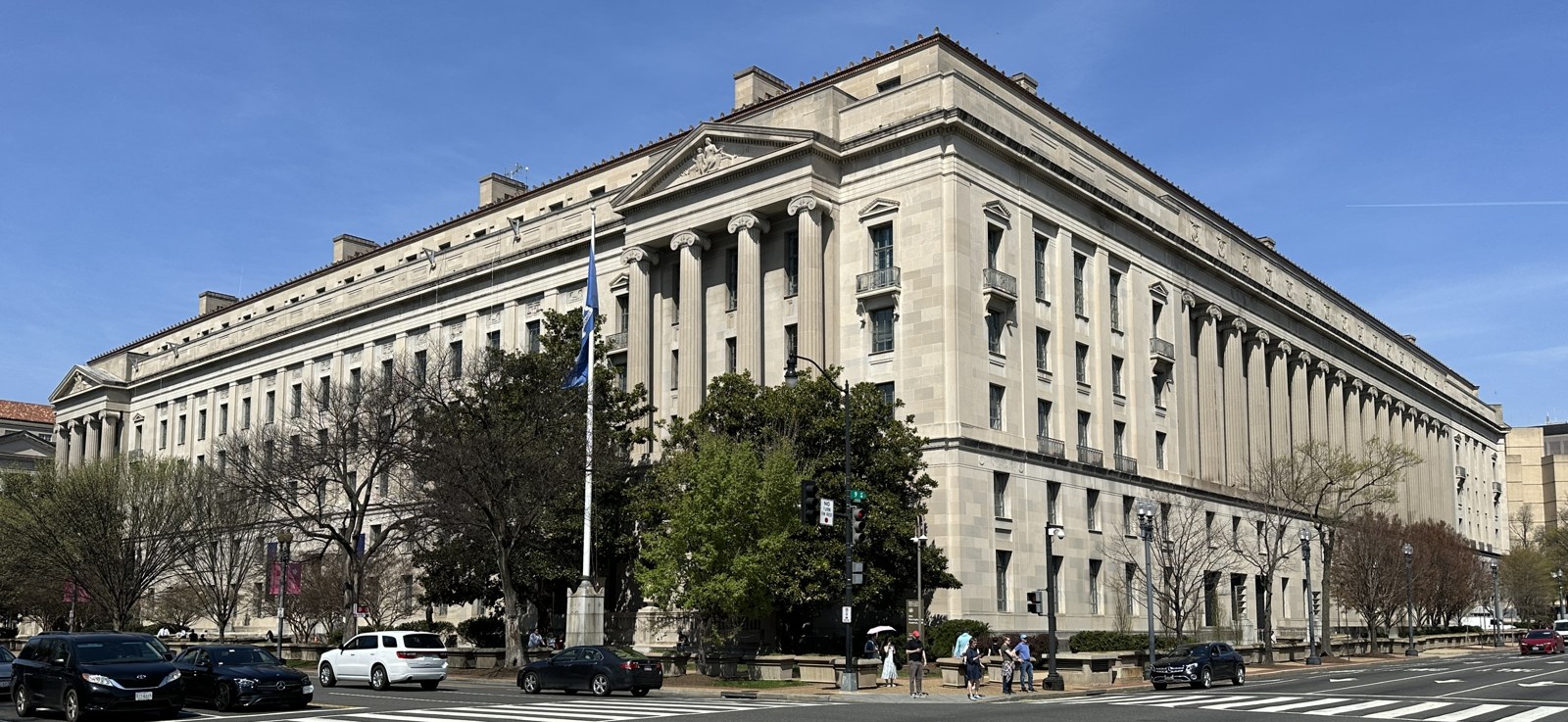
File photo: the Justice Department's Robert F. Kennedy Building in Washington, March 31, 2026. It represents the department litigating the administration's position; it does not depict Memorial Circle, the proposed arch or Monday's proceedings. APK / Wikimedia Commons, CC BY 4.0; resized.

Editorial note: This article draws on the linked sources and may include clearly labeled opinion or unconfirmed reports. We have not independently verified every source claim. Publication does not establish an unconfirmed claim as fact; developing details may change.
Facts first. Side-eye included.
DJF separates what is confirmed from what is claimed—and tells you why this particular mess is worth your time.