Reporting and clearly labeled opinion · October 25, 2026
The play happened Saturday, not this evening
Milwaukee beat Tampa Bay 5–4 in World Series Game 2 on Saturday, October 24, taking a 2–0 series lead. With two outs and a runner on third in the ninth inning, first-base umpire James Hoye ruled that Yandy Díaz had offered at Aaron Ashby’s pitch. The strikeout ended the game. Heavy’s October 25 report explains that the initial ball call was followed by an appeal from catcher William Contreras. The dispute is over that swing ruling, not a newly changed score.
Why Joe Davis is part of the debate
Awful Announcing reported October 25 that Fox broadcaster Joe Davis called for a system to review check swings after the finish. Its account distinguishes the current ball-and-strike challenge process from swing judgments: checking where a pitch traveled does not establish whether a batter offered at it. The report also describes check-swing technology being tested in the minors. Davis’s argument is a proposal for changing the process, not an announcement that MLB has changed the World Series rules.
A rule and a camera answer different questions
The narrow primary-source context is this: MLB announced a Florida State League bat-tracking check-swing experiment in May 2025. That establishes a test, not a major-league entitlement to review. The important design question is what observable movement should count as a swing. A camera can measure movement. People still have to choose the standard, explain it and decide which calls the competition will allow players to challenge.
Opinion: define the target before buying the gadget
Our take: baseball should give players and viewers a clearer standard before selling another round of technological salvation. Otherwise, a slow-motion replay just turns one argument into an argument with better lighting. Anyone who remembers adjusting rabbit ears to watch a game knows clearer pictures are nice. Clearer rules would be an even bigger upgrade. The league should be able to explain a future review standard in words that survive outside a broadcast graphics package.
A fair system has to work in April, too
If baseball expands review, the procedure should be predictable across ordinary games as well as the championship stage. It needs a prompt way to request a challenge, an understandable result and a practical limit on delay. It also needs transparency about what happens when tracking is unavailable. Those are implementation questions, not reasons to declare every disputed call corrupt. A workable system would reduce the role of camera-angle arguments without pretending that judgment can disappear entirely.
The result and the argument can coexist
There is no need to announce that Tampa Bay was robbed in order to scrutinize the rule. Milwaukee won under the ruling made on the field. A future standard could be different without retroactively rewriting that outcome. The useful debate is whether the next batter in the same position should have a clearer explanation and an available review. Keep the criticism attached to the process; leave invented motives for the cheap seats.
More from Daily Junk Food
More Sports & Spectacle · Gen X Files: physical music and the collection you chose
Sources and photograph
- Heavy / Jackson Kruse, October25 report on the October24 final play
- Awful Announcing / Sam Neumann, October25 reporting on Joe Davis and review rules
- MLB, May20,2025 announcement of the Florida State League experiment; archival rules context
- Photograph license: Creative Commons Attribution-ShareAlike 2.0
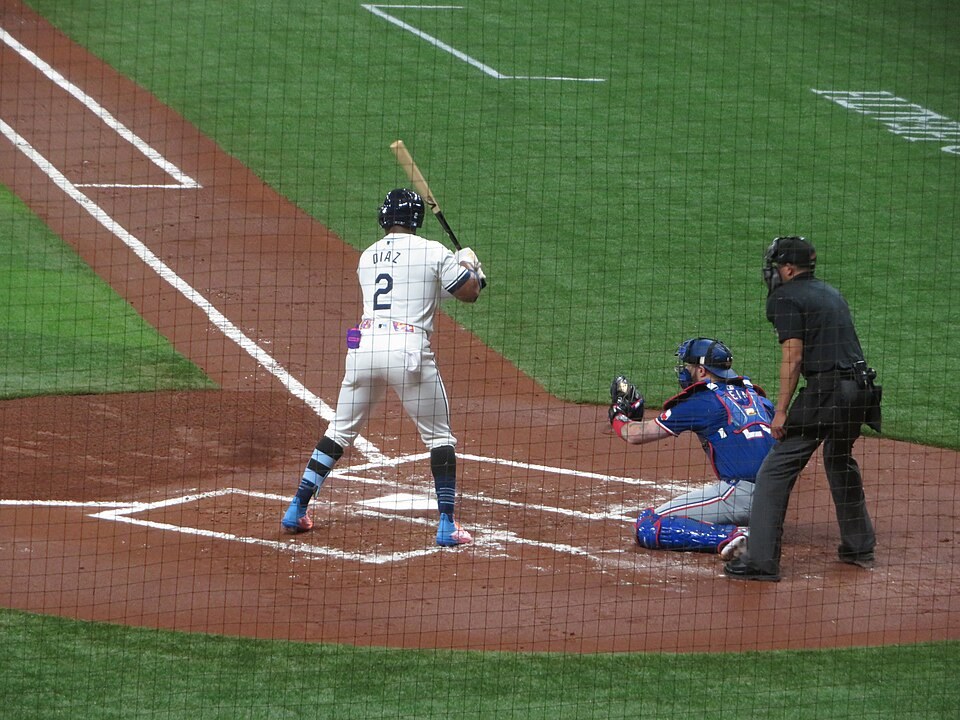
File photograph: Yandy Díaz batting at Tropicana Field on April 1, 2024, against Texas; this does not show the disputed 2026 World Series swing. Photo: Ken Lund, via Wikimedia Commons, CC BY-SA 2.0. Display copy resized; the photograph remains available under that license. Photograph source and rights record.

Editorial note: This article draws on the linked sources and may include clearly labeled opinion or unconfirmed reports. We have not independently verified every source claim. Publication does not establish an unconfirmed claim as fact; developing details may change.
Facts first. Side-eye included.
DJF separates what is confirmed from what is claimed—and tells you why this particular mess is worth your time.