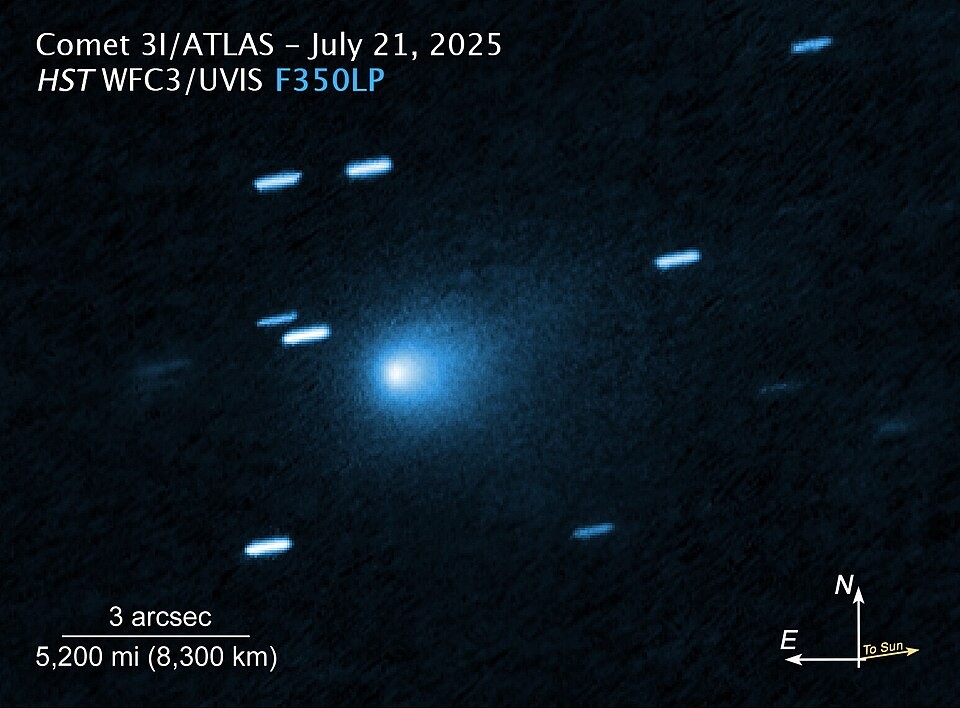
The 3I/ATLAS icy grains paper is a fresh entry in the interstellar-object discussion with an explanation made of actual comet material. Highlighted October 20 by Astrobiology, the study examines changes in the comet’s dusty coma using Zwicky Transient Facility observations. Its proposed explanation involves short-lived icy particles. The aliens will have to wait while someone checks the dust.
Bin Liu and colleagues submitted the paper to arXiv on October 15; its record lists publication in The Astrophysical Journal Letters. They compare observations before and after perihelion, the comet’s closest approach to the Sun. The work concerns archival observations and a new analysis, not an announcement that the comet has just made another solar passage.
The authors report that the inner coma faded differently from the outer regions, while a temporarily blue outer component later disappeared. Their sublimation calculations are consistent with small icy grains containing a modest absorbing carbon component. “Consistent with” is doing real scientific work here: a model can account for observations without becoming a direct photograph of every particle.
Estimated dust-loss rates depend on assumptions about grain sizes and how long material stays in the observed region. That qualification matters because astronomical measurements are interpreted through physical models. Changing an assumption can change an inferred quantity. It is not an embarrassing footnote; it is part of explaining what the result actually supports.
Our take: interstellar does not mean artificial. A comet originating outside our solar system is already extraordinary without being reassigned a cockpit. This paper asks a narrower, testable question about brightness, color and material loss. Those details help characterize a visitor from another planetary environment while keeping the interpretation attached to the measurements.
The study provides no confirmation of extraterrestrial organisms, a technological craft or an intelligence behind the object. It offers an icy-grain explanation for an evolving coma. Further observations and modeling can test how well that account holds. The universe has produced an interesting object; it does not owe the internet a pilot just because the object arrived from elsewhere.
Sources and photograph
Research paper, submitted October 15; Astrophysical Journal Letters reference. Astrobiology research highlight, October 20.
Real telescope observation of 3I/ATLAS captured by Hubble July 21, 2025; processed and annotated astronomical image, not the ZTF observations analyzed in the new paper. Photo: NASA, ESA, D. Jewitt (UCLA); Image Processing: J. DePasquale (STScI); ESA/Hubble; CC BY 4.0. Display copy resized. Where applicable, the resized photograph retains the stated ShareAlike license. Original photograph and rights record. Image-use terms.

More from this Daily Junk Food section.
Facts first. Side-eye included.
DJF separates what is confirmed from what is claimed—and tells you why this particular mess is worth your time.

Dana Side-Eye
Receipts, Rumors & Internet NonsenseDana reads the fine print, checks the timeline, and keeps one eyebrow permanently raised. She covers viral claims, internet pile-ons, and suspiciously convenient explanations.
“Screenshots are forever. So is the side-eye.”