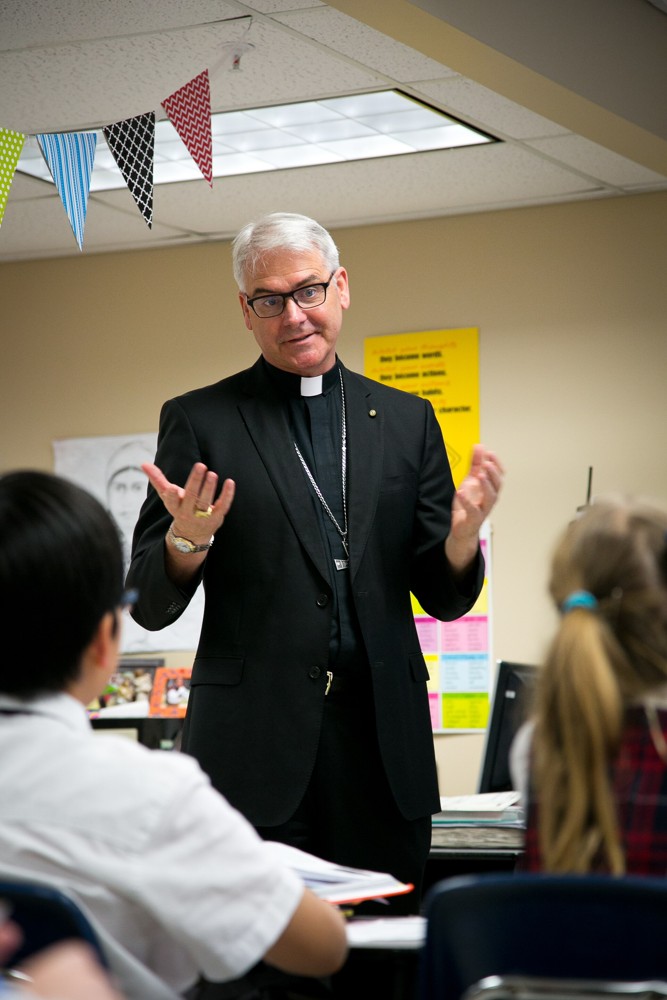
Archbishop Paul Coakley is asking Catholics to put faith before politics as the November 3 election approaches. In an October 14 message receiving fresh coverage October 15, the president of the U.S. Conference of Catholic Bishops described voting as both a right and a responsibility. The statement encourages participation, not a retreat into permanent political despair.
Coakley calls for free and fair elections and urges people not to leave registration or voting unnecessarily late. His broader argument places religious commitments ahead of party allegiance. It is a message about how Catholics should approach civic judgment, not an announcement that a particular campaign has received the church’s endorsement.
The statement also makes room for criticism of one’s own political side. It emphasizes human dignity, conduct rather than promises, and resistance to division and resentment. That is a substantial distinction from treating a party’s entire platform as a package that must be accepted to keep one’s membership card in good standing.
Analysis: the difficult part is not repeating “values” until the word loses all molecular structure. It is applying a standard when it inconveniences the team one usually supports. A moral framework that only detects misconduct across the aisle is less a framework than an extremely well-funded motion sensor pointed in one direction.
The bishops’ message does not remove disagreements about how principles translate into policy. Catholics can still dispute priorities and practical consequences. What it challenges is the assumption that political loyalty should settle every question in advance. That matters in a climate where thoughtful qualification is regularly mistaken for an equipment malfunction.
There is a practical civic point beneath the spiritual language. Participation requires attention to the actual process, while fair elections require more than accepting outcomes one likes. Coakley’s appeal links responsibility and engagement rather than offering cynicism as a sophisticated alternative. Being exhausted by politics is understandable; exhaustion is not itself a voting plan.
Readers can consult the full message rather than relying on a campaign’s selectively highlighted fragment. It is neither a candidate scorecard nor a promise that the choices will become simple. Its central demand is independence of conscience. The party may ask for your vote. That does not automatically entitle it to custody of your entire moral compass.
Sources and photograph
USCCB, Archbishop Coakley’s October 14 message. OSV News, October 15 coverage.
File photograph of Archbishop Paul Coakley; not a photograph of the October 14 message being delivered. Photo: allsaintsphotos; CC BY 2.0. Display copy resized. Original photograph and rights record. Image-use terms.

More from this Daily Junk Food section.
Facts first. Side-eye included.
DJF separates what is confirmed from what is claimed—and tells you why this particular mess is worth your time.

Dana Side-Eye
Receipts, Rumors & Internet NonsenseDana reads the fine print, checks the timeline, and keeps one eyebrow permanently raised. She covers viral claims, internet pile-ons, and suspiciously convenient explanations.
“Screenshots are forever. So is the side-eye.”