The Habitable Worlds Observatory imager concept is a fresh piece of engineering work connected to the search for life beyond Earth. A preprint submitted October 21 by Vincent Van Eylen and colleagues presents a proposed High Resolution Imager for the future observatory. Astrobiology highlighted it October 23. The authors describe a camera with imaging, spectroscopy and precision-measurement duties, alongside guidance and sensing functions.
The optical concept splits incoming light into ultraviolet-to-visible and near-infrared channels for simultaneous observations. The authors aim to reduce unnecessary reflections to improve the light reaching the detectors while managing stability and optical error. The paper is listed as submitted to RASTI’s HWO special issue; the public record reviewed here is a preprint, not a completed instrument or a report of observations.
Its relevance to astrobiology lies in preparation for a mission intended to investigate nearby planetary systems and search for signs of life. Designing one camera does not demonstrate that any planet is inhabited. It also should not be confused with approving a final observatory configuration, completing construction or scheduling a launch. A proposal describes an engineering path that can be examined and revised.
Our take: alien-life research includes a substantial amount of deciding what the camera must actually do. That may sound less exciting than a mysterious light in a shaky video, but measurement quality is where the difficult questions eventually land. If you want to make a strong claim about a distant world, the instrument has to deliver information capable of surviving the obvious skeptical questions.
A useful design paper exposes trade-offs instead of hiding them behind a beautiful spacecraft rendering. Every optical choice connects with other requirements. The point is to make those choices explicit enough for other researchers to assess. That is a form of progress even when the honest headline contains the uncinematic word concept.
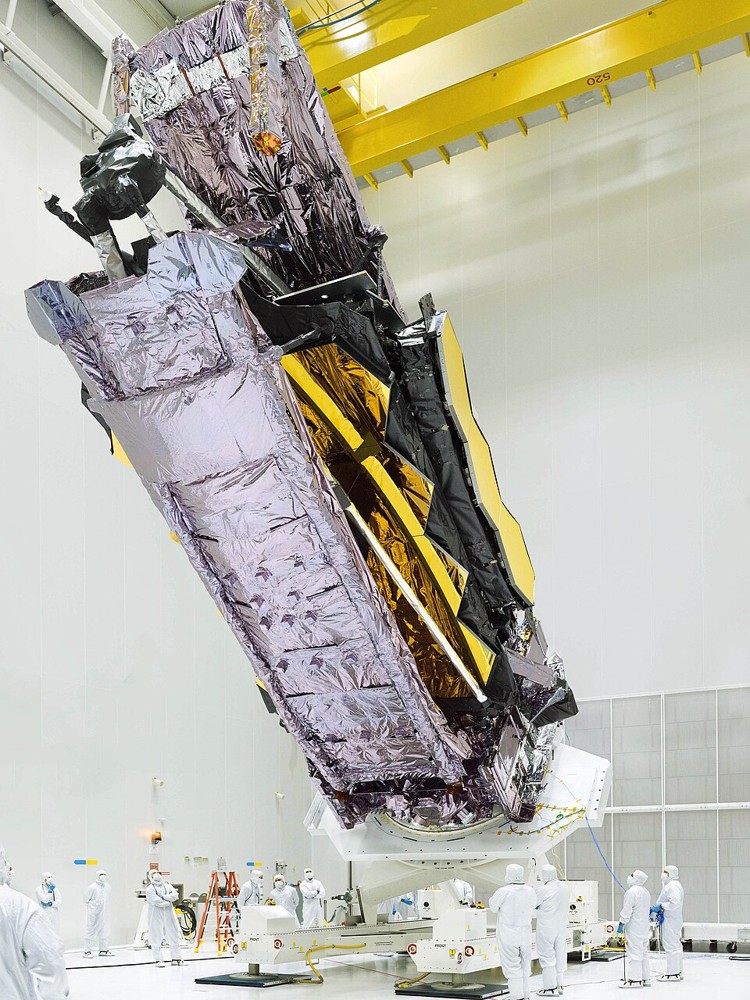
The real photograph shows Webb being prepared in a cleanroom, not HWO hardware. It illustrates the engineering context and is captioned accordingly. The verified new development is the published imager proposal and its stated capabilities. No alien organism, technosignature or inhabited planet has been confirmed by this paper. Researchers are refining a way to look; the universe has not yet supplied the result that a future instrument might help test.
Sources and photograph
Van Eylen and colleagues, October 21 primary preprint, arXiv 2610.29957. Astrobiology, October 23 research highlight.
Archival NASA photograph of Webb, used to illustrate space-telescope engineering; not the proposed Habitable Worlds Observatory or its imager. Photo: NASA/Chris Gunn; Public domain (NASA). Display copy resized. Where applicable, the resized photograph retains the stated ShareAlike license. Original photograph and rights record. Image-use terms.


More from this Daily Junk Food section.
Facts first. Side-eye included.
DJF separates what is confirmed from what is claimed—and tells you why this particular mess is worth your time.

Dana Side-Eye
Receipts, Rumors & Internet NonsenseDana reads the fine print, checks the timeline, and keeps one eyebrow permanently raised. She covers viral claims, internet pile-ons, and suspiciously convenient explanations.
“Screenshots are forever. So is the side-eye.”