A meteorite organic chemistry review highlighted October 22 provides a useful answer to a recurring extraterrestrial-life question: how much interesting chemistry can happen without life? Libby D. Tunney, Paul H. M. Harrison and Gregory F. Slater examine pathways that could produce complex organic molecules in meteorites. Their Astrobiology article first appeared online October 7. It is a review of chemistry, not an announcement that somebody found an alien in a rock.
The authors consider mechanisms starting from nine simple precursor molecules, including water, ammonia and hydrogen cyanide, and assess experimental work. They identify gaps in understanding reaction yields and processes. Distinguishing nonbiological production from biological signatures, including terrestrial contamination, is central to the problem. The freshly published highlight brings attention to that synthesis; it does not change the review into a new meteorite recovery.
This angle differs from reporting a particular meteorite’s analysis. A review asks how results and proposed mechanisms fit together, and where the evidence remains incomplete. Readers should not infer that every pathway discussed has been shown to operate identically in every meteorite. A collection of plausible routes is a research framework, not a universal recipe printed on the underside of an asteroid.
Our take: the fascinating part is that chemistry can provide ingredients without providing organisms. Finding an ingredient raises questions about its origin and context. It does not tell you that a living system assembled or used it. A pantry containing flour is not proof that someone has baked a cake, however enthusiastically the headline announces dessert.
For the search for life, a strong nonbiological explanation is valuable information rather than a disappointing technicality. Investigators need to understand what an environment can make on its own before deciding that an observation requires biology. Better competing explanations make any future life claim more demanding, which is precisely what a claim of that importance should face.
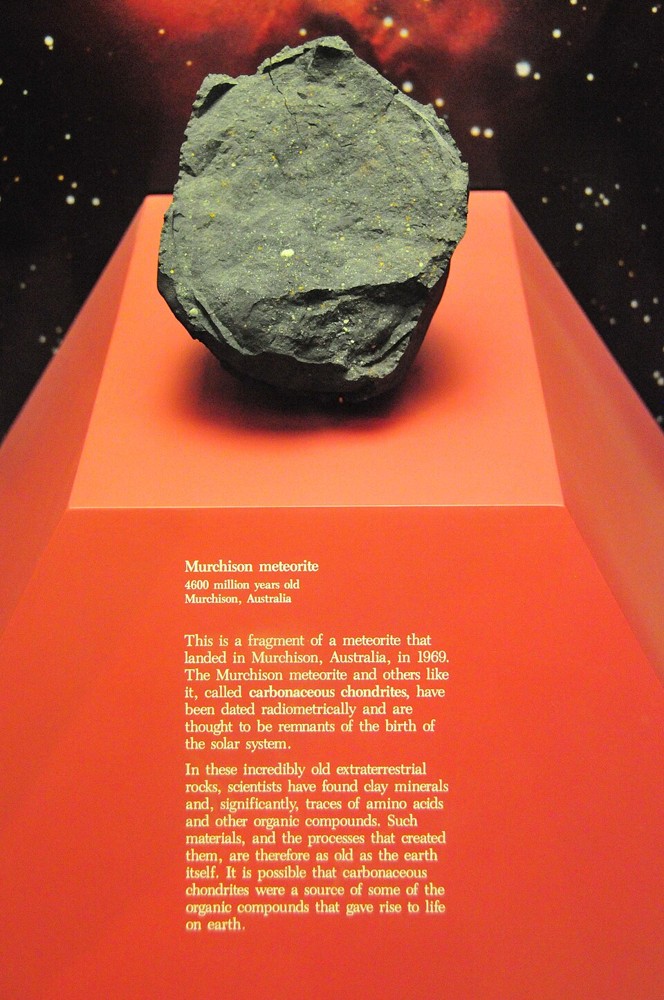
The accompanying real photograph shows a museum specimen of the Murchison meteorite in 2008. It is illustrative, not the subject of a newly announced recovery. No UFO sighting count, extraterrestrial organism or government confirmation is established by this paper. The credible development is a clearer account of chemical possibilities and remaining questions. Space remains interesting even when its latest contribution refuses to pose for an alien driver’s license.
Sources and photograph
Tunney, Harrison and Slater, Astrobiology review, first published October 7. Astrobiology, October 22 research highlight.
Archival 2008 photograph of a Murchison meteorite specimen; illustrative of meteorite research, not a newly recovered sample. Photo: Art Bromage; CC BY-SA 2.0. Display copy resized. Where applicable, the resized photograph retains the stated ShareAlike license. Original photograph and rights record. Image-use terms.

More from this Daily Junk Food section.
Facts first. Side-eye included.
DJF separates what is confirmed from what is claimed—and tells you why this particular mess is worth your time.

Dana Side-Eye
Receipts, Rumors & Internet NonsenseDana reads the fine print, checks the timeline, and keeps one eyebrow permanently raised. She covers viral claims, internet pile-ons, and suspiciously convenient explanations.
“Screenshots are forever. So is the side-eye.”