The ocean world ice amino acids study examines a difficult part of the habitability question: how useful chemistry moves through a planet or moon. Published October 21 in Science Advances and highlighted October 23 by Astrobiology, the work tests glycine and alanine under conditions that form high-pressure ice VI and VII. The measurements come from a diamond-anvil laboratory experiment, not a spacecraft finding organisms.
The researchers report that both amino acids can enter those ice phases as the ice grows. That matters because thick high-pressure ice layers in large ocean worlds can separate liquid water from a rocky interior. Incorporation might help move compounds through some pathways while also drawing them out of the liquid reservoir. The result complicates the chemistry; it does not make every icy ocean automatically habitable.
The author-uploaded paper says future work should connect the measured behavior with geophysical models of transport and remelting. The experiment establishes compatibility under its tested conditions. How much material would arrive in a particular extraterrestrial ocean, and whether that ocean could sustain life, remain additional questions. Amino acids are chemical ingredients, not organisms or an alien confirmation.
Our take: this is the kind of extraterrestrial-life research that rarely gets the dramatic soundtrack it deserves. The central question is essentially whether the ingredients can reach the kitchen. A world can look promising on a simplified diagram while its interior makes delivery inconvenient. Science earns its keep by replacing that diagram’s confident arrows with measurements.
There is a useful distinction between identifying a possible mechanism and declaring a destination alive. The former gives researchers something to test, refine and compare with planetary models. The latter would demand evidence this experiment does not provide. Keeping that distinction intact does not drain the discovery of interest; it tells us exactly why the next experiment matters.
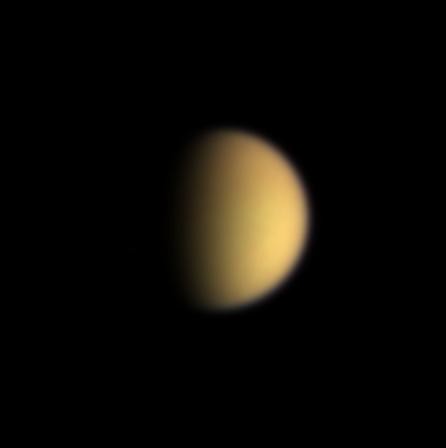
The real Cassini photograph shows Titan as context for ocean-world research. It is not an image of high-pressure ice being sampled, and it cannot reveal the moon’s hidden chemistry on its own. The current advance is a measured relationship between molecules and ice. The universe has not sent a greeting. Researchers have improved one part of the very long checklist for deciding where a greeting could plausibly originate.
Sources and photograph
Hao and colleagues, Science Advances, October 21 paper DOI. Author-uploaded full text, made available October 22. Astrobiology, October 23 research highlight.
Archival Cassini photograph of Titan, used as ocean-world context; not the laboratory experiment, a view through its interior or evidence of life. Photo: NASA/JPL/Space Science Institute; JPL image-use policy (journalistic use). Display copy resized. Where applicable, the resized photograph retains the stated ShareAlike license. Original photograph and rights record. Image-use terms.
More from this Daily Junk Food section.
Facts first. Side-eye included.
DJF separates what is confirmed from what is claimed—and tells you why this particular mess is worth your time.

Dana Side-Eye
Receipts, Rumors & Internet NonsenseDana reads the fine print, checks the timeline, and keeps one eyebrow permanently raised. She covers viral claims, internet pile-ons, and suspiciously convenient explanations.
“Screenshots are forever. So is the side-eye.”