Prebiotic organic films and biomorphs are the subject of a newly highlighted experiment that makes the search for life more interesting and more demanding. Christian Jenewein and colleagues studied solid material produced in spark-discharge chemistry, finding hollow forms that can resemble biological structures. Their Astrobiology paper first appeared online October 7 and received an October 22 research highlight. It reports chemistry, not alien organisms.
Using electron microscopy and spectroscopy, the researchers examined how composition varied across the films. The abstract links spherical and other hollow forms to hydrated interfaces and differences in local chemistry. It also discusses potential shielding of fragile compounds from near-ultraviolet light. The suggested relevance is to the emergence of life; the experiment does not establish living cells or reproduce an entire origin-of-life sequence.
Our take: a cell-like outline is an observation that needs an explanation. Calling the outline a cell before establishing biology skips the question the research is trying to illuminate. Shape can invite investigation without settling origin. A photograph that looks familiar is not a laboratory result with all the remaining tests conveniently waived.
That distinction matters when people consider possible signs of life beyond Earth. A convincing interpretation must ask what nonliving processes could create the same feature. Understanding those processes is useful progress, even when it removes an easy answer. It helps future investigators decide which observations would actually separate competing explanations.
This story concerns an experiment on films and interfaces, distinct from the meteorite-chemistry review covered earlier. Neither supplies evidence of extraterrestrial life. The shared larger question is how chemistry becomes organized and what would justify moving from interesting material to a biological claim. That transition deserves more than an enthusiastic circle drawn around a microscopic blob.
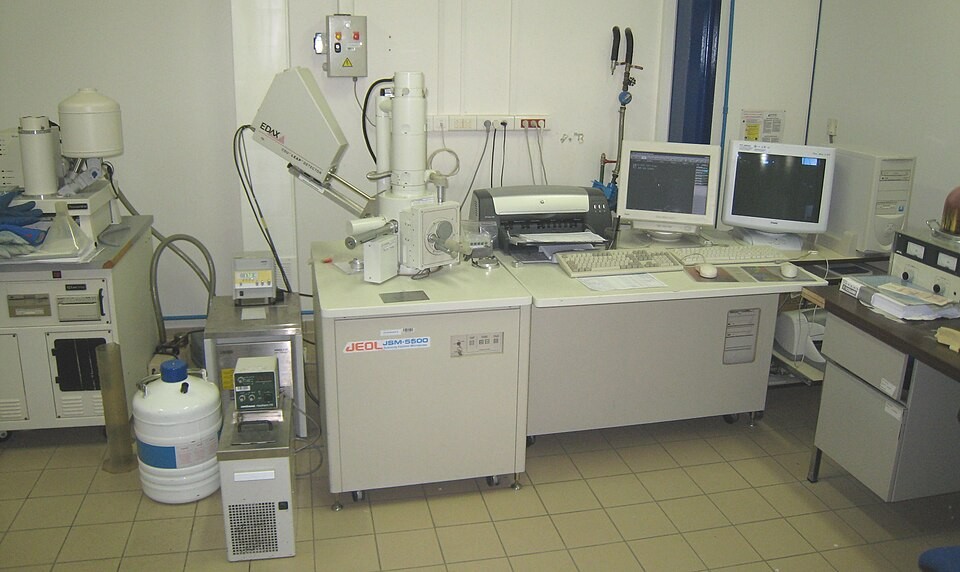
The real photograph shows representative electron-microscopy equipment, not this study’s apparatus or results. The article is based on the published abstract, with that limit kept intact. The credible update is a closer look at structures nonliving chemistry can produce. Scientists have given the alien-confirmation industry another useful reason to read past the picture caption before ordering the commemorative T-shirts.
Sources and photograph
Jenewein and colleagues, Astrobiology, first published October 7. Astrobiology, October 22 research highlight.
Representative laboratory-equipment photograph; not the apparatus, researchers or biomorphs from the reported study. Photo: Cjp24; CC BY-SA 3.0. Display copy resized. Where applicable, the resized photograph retains the stated ShareAlike license. Original photograph and rights record. Image-use terms.

More from this Daily Junk Food section.
Facts first. Side-eye included.
DJF separates what is confirmed from what is claimed—and tells you why this particular mess is worth your time.

Dana Side-Eye
Receipts, Rumors & Internet NonsenseDana reads the fine print, checks the timeline, and keeps one eyebrow permanently raised. She covers viral claims, internet pile-ons, and suspiciously convenient explanations.
“Screenshots are forever. So is the side-eye.”