Hydrogen exomoon habitability is back in recent science coverage, with an October 17 Astrobiology article revisiting work announced by LMU Munich in March. The model explores whether moons of planets drifting without a parent star could keep surface water liquid. This is not an October discovery of an inhabited moon. The dates and the word model are doing actual work in that sentence.
The team’s account combines two possible ingredients: tidal heating from a moon’s changing orbit and a dense hydrogen atmosphere that retains heat. Under the modeled conditions, liquid-water environments could persist for up to 4.3 billion years. That figure describes a result within the study’s assumptions, not the measured age of an ocean discovered somewhere in the dark.
The heat-trapping mechanism involves collisions among hydrogen molecules under pressure. The researchers also discuss how repeated deformation could contribute to wet-and-dry cycling relevant to prebiotic chemistry. These ideas expand the kinds of environments worth considering in life research. They do not show that an actual moon has the required atmosphere, ocean, chemistry or organisms.
Our take: the appeal is the challenge to an intuitive picture. When people imagine a life-friendly world, they tend to put a sun in the sky before they do anything else. A model can ask whether another energy budget might work. That is a productive question even if the answer depends on conditions that turn out to be uncommon. Science is allowed to explore possibilities without promising a property listing.
The next distinction is between maintaining suitable conditions and producing life. Those are not interchangeable achievements. A long-lived ocean would be an environment to investigate, not a witness statement from its residents. We can find the possibility fascinating without upgrading a calculation into confirmation. The universe will not become less interesting because a headline remembers its verbs.
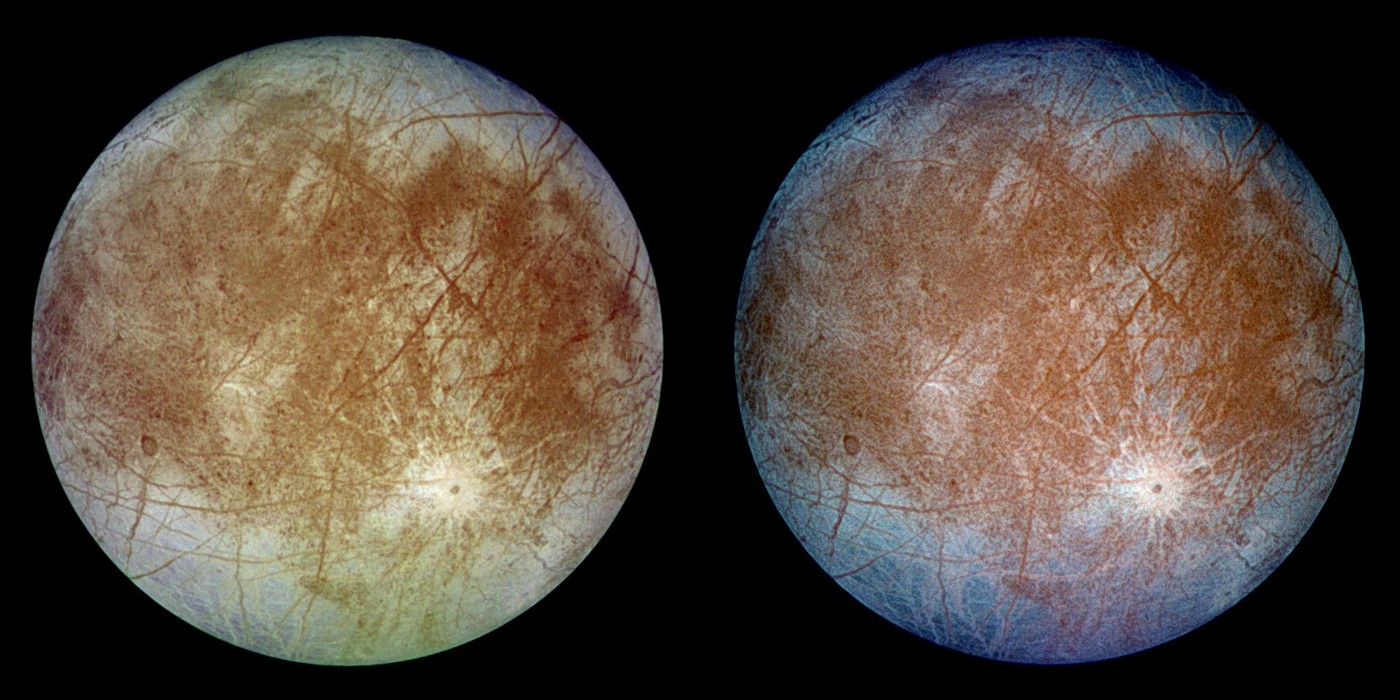
The artwork used in some research publicity is generated, so this article instead uses clearly labeled real spacecraft photographs of Europa as solar-system context. Europa is not a rogue-planet exomoon. The original research release is dated March 11, and the recent revisit October 17. This is an explanatory look at that renewed coverage, not a claim that the underlying study or an alien finding appeared today.
Sources and photograph
LMU Munich, original March 11 research release. ORIGINS, research-team account. Astrobiology, October 17 revisit.
Archival Galileo photographic composites of Europa, captured September 7, 1996: approximate natural color at left, false color at right. Solar-system context only, not an exomoon or a modeled hydrogen atmosphere. Photo: NASA/JPL/DLR; JPL image-use policy (journalistic use). Display copy resized. Where applicable, the resized photograph retains the stated ShareAlike license. Original photograph and rights record. Image-use terms.
More from this Daily Junk Food section.
Facts first. Side-eye included.
DJF separates what is confirmed from what is claimed—and tells you why this particular mess is worth your time.

Dana Side-Eye
Receipts, Rumors & Internet NonsenseDana reads the fine print, checks the timeline, and keeps one eyebrow permanently raised. She covers viral claims, internet pile-ons, and suspiciously convenient explanations.
“Screenshots are forever. So is the side-eye.”