The Titan tholin laboratory study posted to arXiv October 13 asks a physical question about organic material associated with a world of astrobiological interest: how stiff is it? The research was highlighted by Astrobiology.com October 15 and carries a Journal of Geophysical Research: Planets reference. It does not announce life on Saturn’s moon. Sometimes the road toward understanding an alien environment begins with testing how material responds to stress.
Tholins in this study are complex organic solids made in the laboratory by simulating atmospheric photochemistry. They are analogs, not samples brought back from Titan. Mark A. Johnson and colleagues used Brillouin spectroscopy to determine their elastic properties. The distinction between a simulated material and an actual extraterrestrial sample belongs near the top of the account, not concealed behind the exciting planet name.
The authors report measurements of powder and thin-film samples and find substantial stiffness compared with other Titan-relevant organic compounds. They connect the results with questions about dune sediments and future geophysical investigations by Dragonfly. They also report changes after atmospheric exposure, emphasizing the importance of controlled sample handling. These are experimental findings and proposed implications, not a direct inspection of Titan’s entire surface.
Analysis: a search for life does not consist solely of recognizing an interesting molecule. Scientists also need to understand the environment in which a measurement will be made and the material that instruments may encounter. Physical properties can help frame those questions without serving as a biological signal themselves. Stiffness is not a secret alternate spelling of metabolism.
Laboratory analogs are useful precisely when their limits remain visible. A result describes material prepared and measured under specified conditions. Extending it to a distant moon requires an argument about how well the analog represents the relevant environment. Calling something a Titan analog is a reason to inspect that argument, not a guarantee that every grain on Titan behaves identically.
The exposure issue is especially instructive. If handling changes a sample, researchers must distinguish a property of the prepared material from a change introduced during an experiment. That kind of control can look less glamorous than a spacecraft image, but it is part of making future observations interpretable. The tidy graph depends on the untidy business of keeping track of what happened to the sample.
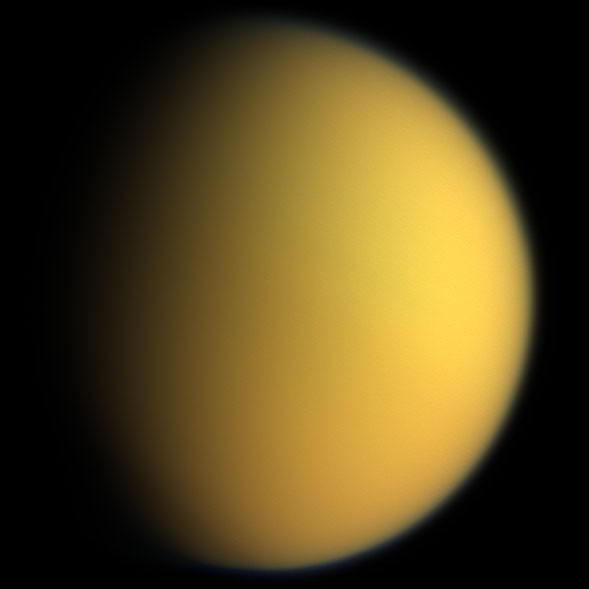
The fresh development is a newly posted, journal-referenced materials study with relevance to understanding Titan and future mission science. No organism, biosignature or extraterrestrial technology was detected. The accompanying Cassini view is real spacecraft photography, not an image of the experiment. A distant orange moon can be fascinating without being asked to confirm aliens every time someone publishes a useful measurement.
Sources and photograph
Johnson and colleagues, arXiv record posted October 13. Journal of Geophysical Research: Planets paper. Astrobiology.com, October 15 coverage.
Natural-color composite assembled from real Cassini camera exposures during the April 16, 2005 Titan flyby; not an illustration, a laboratory sample or a life detection. Photo: NASA/JPL/Space Science Institute; Public domain. Display copy resized. Original photograph and rights record.

More from this Daily Junk Food section.
Facts first. Side-eye included.
DJF separates what is confirmed from what is claimed—and tells you why this particular mess is worth your time.

Dana Side-Eye
Receipts, Rumors & Internet NonsenseDana reads the fine print, checks the timeline, and keeps one eyebrow permanently raised. She covers viral claims, internet pile-ons, and suspiciously convenient explanations.
“Screenshots are forever. So is the side-eye.”