Researchers using James Webb Space Telescope data have reconstructed the atmosphere of WASP-17b as a distorted three-dimensional form rather than the tidy circle used in most diagrams. The hot Jupiter orbits extremely close to its star, producing intense heating and powerful atmospheric dynamics. The result is a better map of an alien world, not an announcement that anybody lives there.
The method, called transmission strings, examines how different slices of the planet’s atmosphere block starlight during transit. Instead of reducing the atmosphere to a single average, the approach extracts information about its shape and variations. The University of Bristol announced the work October 14, with researchers from Bristol and Cornell involved.
WASP-17b is a giant gaseous planet, not a second Earth. Its atmosphere is extremely hot, and the study focuses on planetary structure and weather. “Alien planet” in this context means a planet outside our solar system. It does not mean alien civilization, biological detection, radio message or suspicious parking job near Area 51.
Our take: the breakthrough is methodological. Scientists have thousands of confirmed exoplanets, but most remain points of data rather than places whose atmospheres can be mapped in depth. A technique that separates atmospheric regions may help researchers understand winds, temperatures and chemistry with more precision. That is serious progress even if no one can turn it into a blurry saucer thumbnail.
The shape is influenced by the planet’s rapid rotation, strong stellar irradiation and tidal effects. Mapping those differences can improve interpretations of spectra because a lopsided, changing atmosphere may not behave like a uniform shell. Better models reduce the risk of assigning one simple condition to a planet whose skies vary dramatically from one region to another.
This matters to the broader search for life because astronomers need reliable tools before they can interpret the atmospheres of smaller, potentially temperate worlds. WASP-17b itself is not presented as habitable. It serves as a demanding test case for learning how to read distant atmospheres without pretending a familiar molecule or interesting shape is biological proof.
The confirmed story is a new way to reconstruct exoplanet atmospheres and a striking result for one hot Jupiter. The telescope is real, the method is testable and the planet is fascinating. Extraterrestrial life remains unconfirmed. Science has once again delivered something cooler than a hoax and slightly less convenient than a definitive answer.
Sources and photograph
University of Bristol research release, October 14.
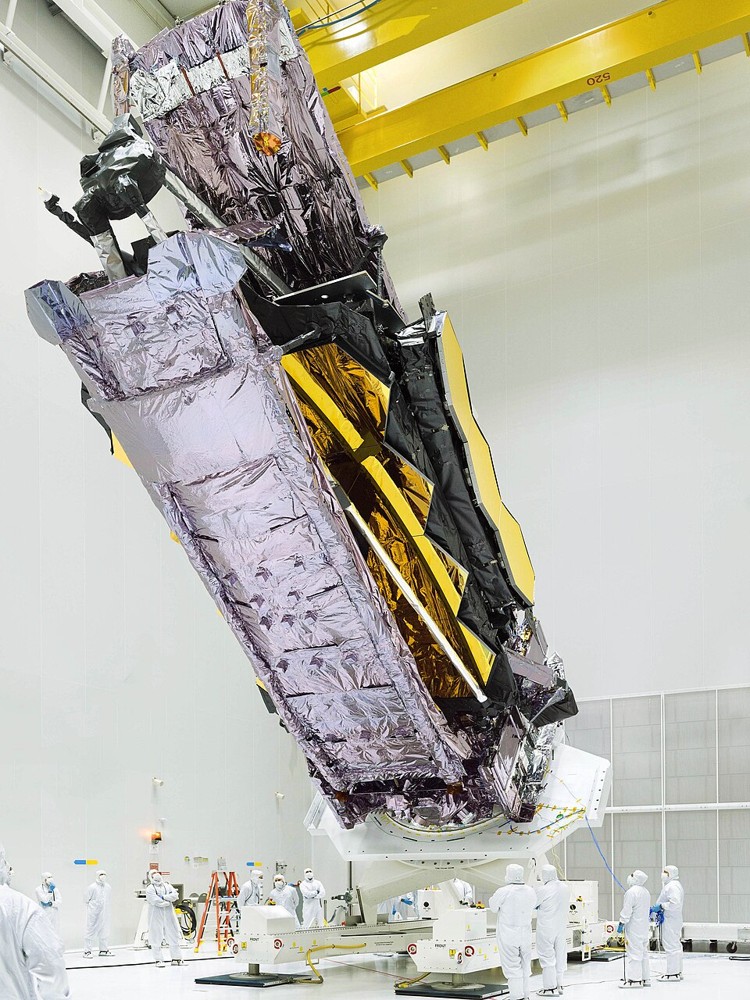
Real pre-launch photograph of JWST in a cleanroom; not an image of WASP-17b or evidence of extraterrestrial life. Photo: NASA/Chris Gunn; Public domain (NASA). Display copy resized. Where applicable, the resized photograph retains the stated ShareAlike license. Original photograph and rights record. Image-use terms.


More from this Daily Junk Food section.
Facts first. Side-eye included.
DJF separates what is confirmed from what is claimed—and tells you why this particular mess is worth your time.

Dana Side-Eye
Receipts, Rumors & Internet NonsenseDana reads the fine print, checks the timeline, and keeps one eyebrow permanently raised. She covers viral claims, internet pile-ons, and suspiciously convenient explanations.
“Screenshots are forever. So is the side-eye.”