Exoplanet photon noise is not the alien headline most likely to get a television panel shouting, but it belongs in the search-for-life conversation. An October 18 Astrobiology.com highlight points to a September 24 preprint by Slava G. Turyshev examining how measurements might distinguish faint reflected planetary light from residual starlight. The paper is a theoretical methods study, not an observation of life and not a newly discovered UFO.
The central obstacle is that subtracting an estimate of unwanted starlight does not erase the photon noise it introduced. The study examines whether information from a wavefront sensor can guide a measurement or improve how its outcome is interpreted. In plain language, knowing something about the glare may help choose how to look, but the hardware and observing-time costs still count.
The model does not promise an across-the-board sensitivity boost. It identifies particular circumstances in which conditional measurements can help, and others in which losses erase the advantage. For the proposed Habitable Worlds Observatory, the relevant possibility involves predictable, directionally varied, leakage-dominated residuals. These are modeled conditions to investigate, not a performance claim for an operating observatory.
That is why this is credible adjacent coverage for the extraterrestrial-life beat. Before an atmospheric spectrum can support a serious interpretation, researchers need to understand what the instrument can reliably separate from the star. Better measurement is part of the route toward asking biological questions. It does not answer those questions by itself, and a methods paper cannot be promoted into alien confirmation by adding an ominous soundtrack.
Our take is that limits are news, too. A technique that works only in a particular regime can still be valuable if that regime is identified honestly. The useful comparison is not a clever method versus a deliberately bad baseline; it is the proposed approach versus an optimized alternative after realistic costs. Science occasionally insists on accounting, even when the marketing department would prefer a breakthrough-shaped balloon.
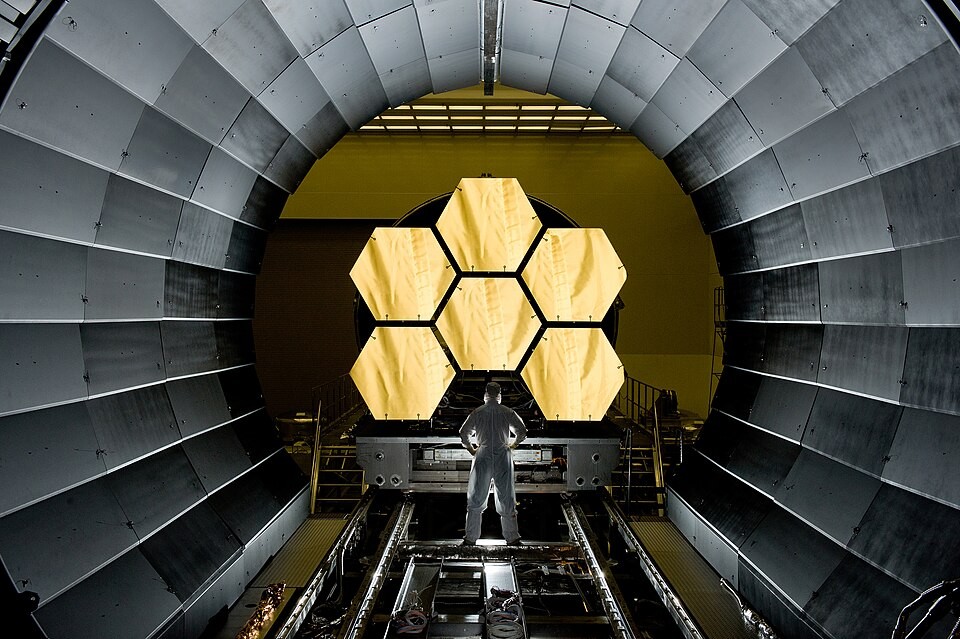
The submission date matters: the preprint is from September, while the fresh research highlight appeared October 18. We are not relabeling it as an overnight discovery. The photograph shows real Webb hardware as clearly marked context, not an image of the proposed system. The verified result is an analysis of measurement trade-offs. Nobody has detected extraterrestrial organisms or an engineered signal in this study.
Sources and photograph
Slava G. Turyshev, arXiv preprint submitted September 24, 2026. Astrobiology.com, October 18 research highlight. NASA, Webb mirror hardware background.
Archival hardware photograph: NASA engineer Ernie Wright beside six James Webb Space Telescope mirror segments at Marshall Space Flight Center, April 14, 2011. Not the proposed Habitable Worlds Observatory, an exoplanet or an alien detection. Photo: NASA/MSFC/David Higginbotham; Public domain (NASA). Display copy resized. Where applicable, the resized photograph retains the stated ShareAlike license. Original photograph and rights record. Image-use terms.

More from this Daily Junk Food section.
Facts first. Side-eye included.
DJF separates what is confirmed from what is claimed—and tells you why this particular mess is worth your time.

Dana Side-Eye
Receipts, Rumors & Internet NonsenseDana reads the fine print, checks the timeline, and keeps one eyebrow permanently raised. She covers viral claims, internet pile-ons, and suspiciously convenient explanations.
“Screenshots are forever. So is the side-eye.”