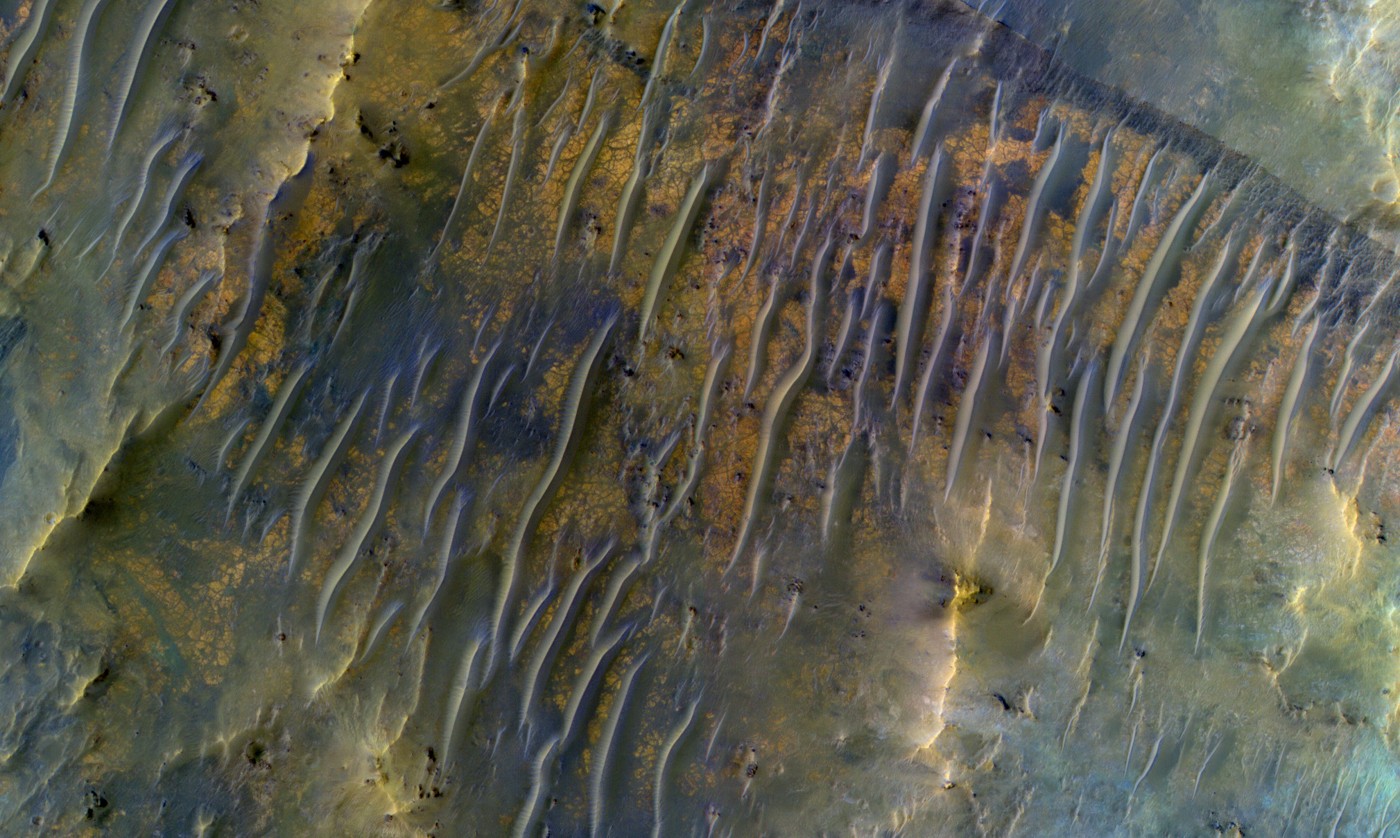
Mars ancient clays are the focus of HiRISE’s October 16 Picture of the Day, highlighted by Astrobiology October 17. The real spacecraft image shows clay-rich sediments northwest of the giant Hellas impact basin, exposed among dunes and sand. The enhanced-color cutout emphasizes orange tones and polygonal fractures. None of those features is an announced organism, a fossil or a message from somebody who wants their parking validated.
The dates deserve separating. Observation ESP_093165_1555 was acquired June 11, 2026, from an altitude of 256 kilometers. October 16 is the feature’s publication date, not the date a camera suddenly discovered Mars. HiRISE says its black-and-white view spans less than five kilometers, while the enhanced-color portion covers less than one kilometer.
The distinction between a photograph and a biological conclusion is the central point. The source identifies the sediments as clay-rich and describes their surface setting. It does not report a sample analysis showing life. “Ancient” describes the geological subject; it does not establish that anything once lived there. Those are different claims requiring different evidence.
Analysis: for the extraterrestrial-life beat, this is a useful example of how to read a genuine planetary image without adding a creature to every interesting shape. An image can document terrain and guide scientific questions while leaving the life question unanswered. Unanswered is a legitimate scientific condition, not a space that reporting must fill with an exciting guess.
Enhanced color is another important label. It helps readers inspect differences in the scene; it should not be mistaken for a promise that a person standing there would see precisely these colors. Processing a real instrument observation does not make it AI artwork, but the processing still deserves disclosure. The caption should carry that information rather than letting the picture perform a magic trick.
What would justify a stronger biological story? A release explicitly presenting biological evidence and explaining how alternative explanations were tested—not merely a dramatic crop of the same terrain. This update is about a newly featured orbital observation and its limits. Mars remains interesting without a manufactured confirmation. Sometimes the honest space story is an excellent photograph and a question that stays open.
Sources and photograph
University of Arizona HiRISE, October 16 HiPOD release. Astrobiology, October 17 coverage. HiRISE public-domain image usage policy.
Real enhanced-color HiRISE spacecraft photograph, observation ESP_093165_1555, acquired June 11, 2026 and featured October 16. Colors are enhanced; this is not an illustration or evidence of detected organisms. Photo: NASA/JPL-Caltech/University of Arizona; Public domain. Display copy resized. Original photograph and rights record. Image-use terms.
More from this Daily Junk Food section.
Facts first. Side-eye included.
DJF separates what is confirmed from what is claimed—and tells you why this particular mess is worth your time.

Dana Side-Eye
Receipts, Rumors & Internet NonsenseDana reads the fine print, checks the timeline, and keeps one eyebrow permanently raised. She covers viral claims, internet pile-ons, and suspiciously convenient explanations.
“Screenshots are forever. So is the side-eye.”