A new UV starshade ozone study asks a practical question in the search for extraterrestrial life: could a future telescope reliably read the atmospheric clues, or would glare and dust make a mess of the answer? Zahra Ahmed and colleagues posted the work on October 12. No alien announcement. Just scientists checking whether the cosmic evidence collection would actually function.
The preprint models ultraviolet observations of modern-Earth analogs using a starshade with the proposed Habitable Worlds Observatory. Across 108 simulated scenes, the team varied viewing geometry and dust around the target system. They report that robust ozone detection required a photometric signal-to-noise ratio near 30. Under favorable modeled conditions, a Sun-like system ten parsecs away could reach that threshold in roughly three days.
That result is conditional, not a telescope booking confirmation. The authors’ arXiv entry says the paper was submitted to The Astronomical Journal. It is a preprint, and its scenes are simulations rather than newly observed inhabited planets. The modeled ozone measurement also does not establish that an atmosphere containing ozone must be biological. A proposed measurement method is not a finding of life.
The hardware idea is less mystical than its name. NASA JPL describes starshades as shaped structures designed to block a star’s light so a telescope can study much fainter nearby planets. Precision matters because the structure must manage diffracted light, not merely make a big shadow. Think of trying to inspect a firefly beside a stadium floodlight, with considerably more engineering and fewer folding chairs.
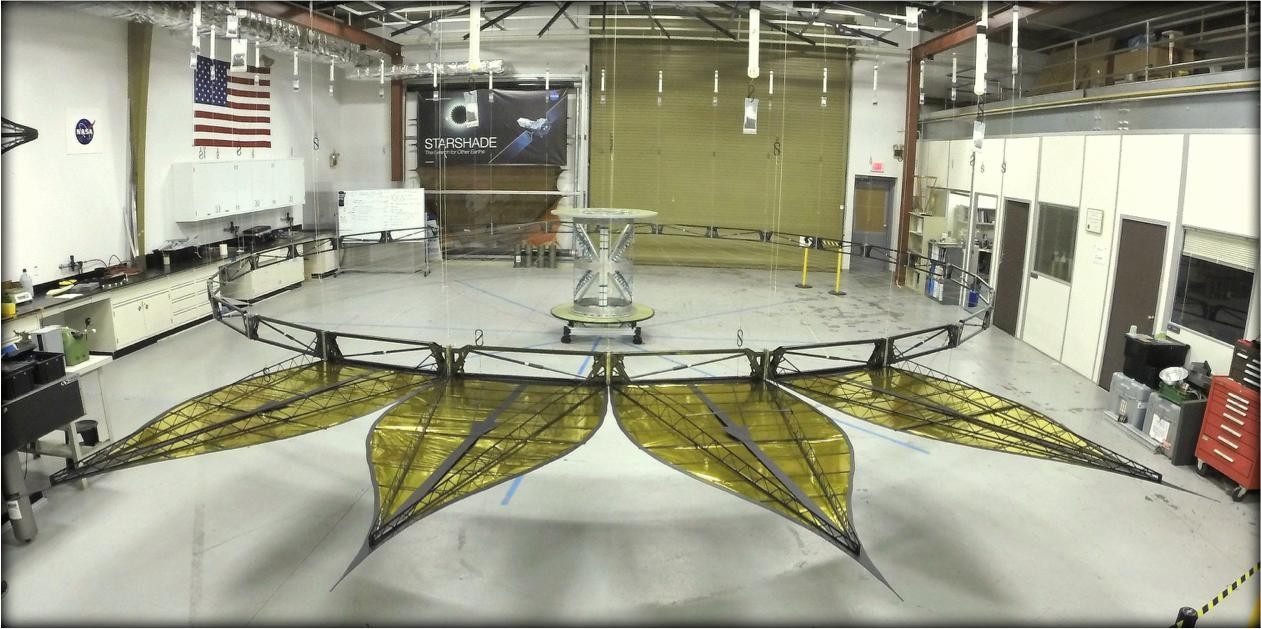
The illustration we are not using is an imaginary alien landscape. The featured image is an actual JPL starshade prototype photographed on Earth in 2014. That archive picture demonstrates work on the technology; it does not show the specific proposed observatory flying today. Keeping the photograph and the research claim separate is basic evidence hygiene.
The substantive advance is the attempt to connect simulated observations, data processing, and atmospheric interpretation instead of stopping at an attractive concept. It helps define the quality of data a future search would need. The verified fact is that this research has been posted. The possibility it explores is better atmospheric characterization elsewhere. Confirmation that anyone lives there remains firmly outside the paper’s conclusions.
Sources and photograph
Ahmed and colleagues, October 12 preprint. NASA JPL, starshade hardware and purpose. NASA JPL, starshade technology background.
Archival hardware photograph: a half-scale starshade deployed at JPL in 2014. Not an exoplanet photograph or a depiction of an operating space mission. Photo: Courtesy NASA/JPL-Caltech; JPL image-use policy. Display copy resized. Original photograph and rights record. Image-use terms.
More from this Daily Junk Food section.
Facts first. Side-eye included.
DJF separates what is confirmed from what is claimed—and tells you why this particular mess is worth your time.

Dana Side-Eye
Receipts, Rumors & Internet NonsenseDana reads the fine print, checks the timeline, and keeps one eyebrow permanently raised. She covers viral claims, internet pile-ons, and suspiciously convenient explanations.
“Screenshots are forever. So is the side-eye.”