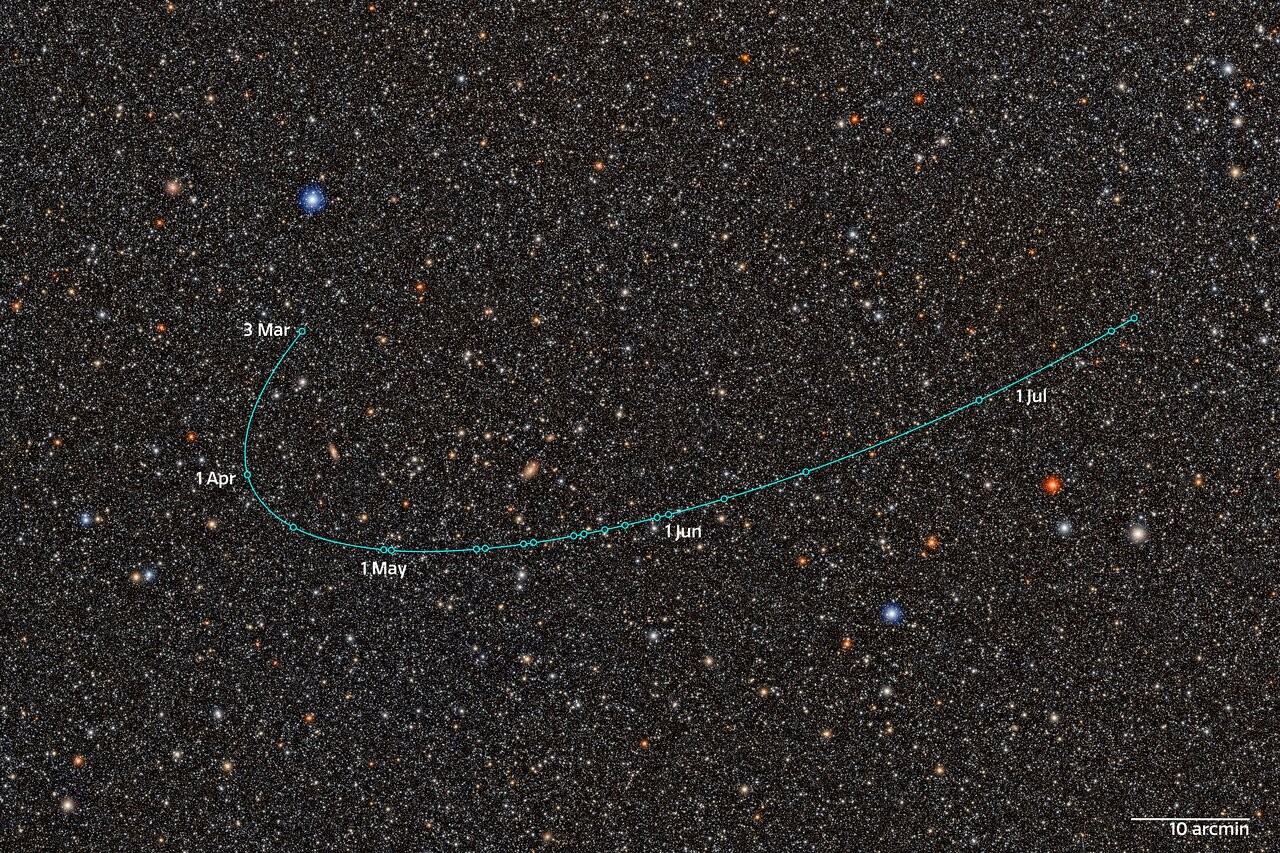
Reported science development — October 29, 2026. Scientists using the NSF–DOE Vera C. Rubin Observatory have identified 2026 ED138 as a possible dwarf planet beyond Pluto. The announcement was October 27, not this morning. Its growing search interest does not change the discovery's date or turn a candidate classification into a confirmed one.
The observatory's original announcement describes an object currently about 46 astronomical units from the Sun and estimates a size between 600 and 1,500 kilometers. Its exact size and nature require further observations, including in infrared light. Those qualifications belong in the headline conversation, not in a tiny correction after the excitement.
A new identification, with older evidence
Rubin's team used observations from March through July 2026, then recovered additional observations. Archival Dark Energy Camera images extended the record to 2016, allowing the team to trace more than ten years of the object's orbit. The discovery announcement and the dates on the underlying images are different pieces of the story.
The National Science Foundation's October 27 release explains that the object was found against a crowded Milky Way star field. Rubin's repeated monitoring and analysis helped distinguish its motion among the background sources. NSF says other observatories can now follow it up.
Why “candidate” earns its place
The observatory explains that dwarf-planet status requires enough mass for gravity to make an object round. Brightness alone does not directly reveal diameter: the estimate also involves how reflective the surface might be. The team's broad size range is a statement about what still needs constraining, not a menu from which to select the most impressive number.
NSF describes this as a potential addition to the recognized dwarf-planet group. It does not announce a replacement ninth planet, a newly found inhabited world or evidence of extraterrestrial technology. There is plenty to investigate without assigning the object a science-fiction job it did not apply for.
DJF analysis: the follow-up is part of the discovery
A provisional identification is not a failed discovery. It is how an honest scientific account shows its working. New observations can narrow an estimate, test an interpretation and make a classification stronger. Treating every qualifier as a weakness encourages headlines that sound decisive precisely where the researchers are being careful.
The useful question is what measurement would resolve the uncertainty. In this case the announcement points to further observations, while the archive supplies the history that helped establish the orbit. A dramatic rendering of a planet would be easier to recognize, but it would also invite readers to mistake an imagined surface for a photographed one.
Our cover therefore uses the observatory's actual processed star-field image with its annotated track. The turquoise line is an overlay tracing the object's path; it is not a glowing trail photographed behind a planet. Read more in Science & Unexplained, including our Europa evidence review, which distinguishes an interesting world from confirmation of life.
Photograph and credit
Image source and caption. Credit: NSF–DOE Vera C. Rubin Observatory/NOIRLab/SLAC/AURA. Image processing: M. Jurić (UW), D. de Martin & M. Zamani (NSF NOIRLab). Media-use terms; CC BY 4.0. Resized. This is an annotated, processed astronomical photograph, not an artist’s surface illustration.
Editorial note: This article draws on the linked sources and may include clearly labeled opinion or unconfirmed reports. We have not independently verified every source claim. Publication does not establish an unconfirmed claim as fact; developing details may change.
Facts first. Side-eye included.
DJF separates what is confirmed from what is claimed—and tells you why this particular mess is worth your time.