Titan Selk crater chemistry is the subject of a new review aimed at a very practical alien-life-adjacent question: where should a future mission look to understand complex chemistry? Catherine D. Neish and colleagues published their review online in Astrobiology on October 7; Astrobiology.com highlighted it October 15. It examines the environment relevant to NASA’s Dragonfly mission. It does not announce organisms, fossils or an extraterrestrial welcome committee.
The review considers the crust where the impact occurred, material supplied by the impactor, and the duration and evolution of water-related reactions in impact melt deposits. Its goal includes identifying promising places to sample and ways to interpret the resulting chemistry. These are questions about an environment and its possible chemical history, not direct measurements newly returned from a landed Dragonfly.
NASA describes Dragonfly as a future rotorcraft mission investigating Titan’s habitability and the chemistry preceding biology. Its current overview lists launch no earlier than July 2028 and arrival in late 2034. Those are plans, not a mission already operating on the moon. A paper can sharpen the scientific questions years before the hardware is in position to ask them.
The distinction between organic chemistry and life remains essential. Carbon-related compounds can be scientifically fascinating without being biological products. Researchers need context: what materials were present, what conditions they encountered and what reactions could have occurred without organisms. That is why a review of an impact setting belongs on this beat. It helps build an interpretation before a tempting result arrives, rather than improvising one around a headline.
Our view is that sampling strategy is part of discovery, not administrative paperwork beneath it. If a mission is going to travel that far, the question of which material tells you what is hardly a minor detail. A spectacular landscape can produce spectacular photographs; a carefully chosen sample can answer a specific question. Ideally science gets both, but the second does not happen just because the first looks good on a desktop.
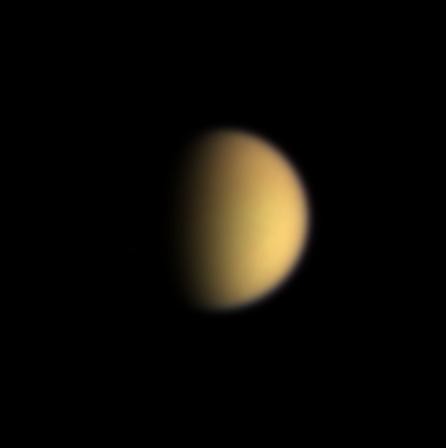
The photograph here is a real Cassini view of Titan’s hazy globe, clearly marked as archival and not as a view through the haze to Selk. The review date and later coverage date are both stated so an October study is not presented as a discovery made this morning. The verified development is a research synthesis for interpreting future chemistry measurements. Alien confirmation remains absent, however much better the alternate headline would perform.
Sources and photograph
Neish and colleagues, Astrobiology review first published October 7. Astrobiology.com, October 15 research highlight. NASA, Dragonfly mission and science overview.
Archival spacecraft photograph of Titan, assembled from Cassini red, green and blue filter images and released July 2, 2004. It shows the moon’s atmospheric haze, not Selk crater’s surface or evidence of life. Photo: NASA/JPL/Space Science Institute; JPL image-use policy (journalistic use). Display copy resized. Where applicable, the resized photograph retains the stated ShareAlike license. Original photograph and rights record. Image-use terms.
More from this Daily Junk Food section.
Facts first. Side-eye included.
DJF separates what is confirmed from what is claimed—and tells you why this particular mess is worth your time.

Dana Side-Eye
Receipts, Rumors & Internet NonsenseDana reads the fine print, checks the timeline, and keeps one eyebrow permanently raised. She covers viral claims, internet pile-ons, and suspiciously convenient explanations.
“Screenshots are forever. So is the side-eye.”